The Silent Crisis Every Programmer Faces Today
Let’s be completely honest for a second. If you are still writing endless "if-else" statements while junior developers are building smart predictive models, you are probably feeling the heat. I get it, because I was exactly where you are right now. You don't need a heavy math degree to catch up, but you do need a massive shift in how you think about logic and data. Let me show you exactly how to make that jump today without losing your mind.
But then, a client asked me to add a feature that could predict user behavior based on past actions. My usual if-then-else statements suddenly felt entirely useless. No matter how many conditions I wrote, the logic kept breaking because human behavior simply does not follow strict, predictable rules.
I felt an overwhelming wave of imposter syndrome wash over me right then and there. For a long time, I tried to ignore the noise around artificial intelligence. I thought it was just a passing trend meant for researchers in academic labs, not for everyday software engineers like me.
But the reality hit me hard when I saw junior developers passing me by simply because they understood how to train a basic predictive model. Traditional developers today are facing a very real and silent crisis. We spend our days maintaining legacy systems while watching intelligent, automated applications take over the market.
This fear slowly eats away at your daily peace of mind and makes you second-guess your career choices. But I soon realized that transitioning to this new way of thinking does not mean throwing away everything we already know. It simply means learning a new set of concepts where data takes the driver's seat instead of manual logic.

Your Quick Action Plan for Today:
- Stop writing the rules: Shift your mindset from writing strict functions to providing great examples and letting the computer find the pattern.
- Clean your mess first: Your code is no longer the star of the show. Clean, accurate data is the only way your model will actually work.
- Don't chase 100% accuracy: A highly accurate model that simply memorizes bad data is completely useless. Always test your models on data they have never seen before.
- Start incredibly small: Ditch the heavy deep learning tutorials and build a basic predictive model on a cheap laptop today.
The Core Mindset Shift: From Writing Rules to Finding Patterns
As software developers, our brains are heavily wired for absolute certainty. We are taught that if we provide a specific input to a function, we will always get a very specific and predictable output. We spend our entire careers writing exact rules to process data and generate answers.
In the world of artificial intelligence, this entire concept gets flipped completely upside down. Instead of writing the rules yourself, you provide the answers and the data to the system first. The algorithm's job is to figure out the hidden rules that connect those inputs to the outputs.
Think of it like teaching a child how to recognize an apple. You do not give the child a strict mathematical formula describing the exact shape, color code, and weight of an apple. Instead, you just show them a dozen different apples and let their brain find the visual patterns.
This is exactly how a machine learning model operates behind the scenes. Your job as a developer shifts from being a strict rule-maker to becoming a guide who provides high-quality examples. You stop telling the computer exactly what to do and start teaching it how to learn from experiences.
This transition from deterministic thinking to probabilistic thinking is the hardest mental block for traditional programmers to overcome. We have to accept that our new systems will not always give a 100% perfect answer every single time. Instead, they will give us the most likely answer based on the statistical patterns they have absorbed.
Why Your Data Is Suddenly More Important Than Your Syntax
In standard web or mobile development, your code is the most valuable asset you have. If your application has a bug, you open your code editor, find the flawed logical statement, and fix the syntax directly. The data in your database is just passive information waiting to be displayed to the user.
When you start building intelligent models, the code itself is often surprisingly simple. The true intelligence of your application lives entirely within the dataset you use to train it. If your model makes a terrible prediction, the problem is rarely a missing semicolon or a poorly written loop.
The problem almost always comes down to the quality, quantity, and diversity of your data. If you feed an algorithm biased, incomplete, or messy information, it will confidently output terrible results. This is the classic concept of "garbage in, garbage out," but it matters ten times more in predictive engineering.
You will find yourself spending significantly less time writing complex functions. Instead, you will spend your days cleaning datasets, handling missing values, and formatting information so the computer can actually digest it. Data preparation becomes your new debugging process.

I actually learned this the hard way during my first prediction project when I tried to build a simple house price estimator. I spent weeks tweaking the complex algorithm settings, but my predictions remained completely wrong because I had accidentally included houses with zero square footage in my dataset. Always clean your data before you even think about touching the model, because a simple model with great data will always beat a complex model with bad data.
Understanding Features and Labels Without the Heavy Math
When experts talk about teaching computers, they throw around academic words that make the subject sound terrifying. Two of the most common terms you will hear are Features and Labels. As a traditional programmer, you actually already understand these concepts under different names.
A Feature is simply an input variable or a specific characteristic of the item you are looking at. If you are trying to predict whether an email is spam or not, the features would be the sender's address, the number of links inside, and the subject line. In a normal database, features are just the columns in your SQL table.
A Label, on the other hand, is the final answer or the specific target you want the computer to predict. In our email example, the label is the simple tag that says "Spam" or "Not Spam." Your goal is to help the computer understand the hidden relationship between those features and that final label.
When you have a dataset where every row has clearly defined features and a known label, you are doing something called Supervised Learning. It is called "supervised" because you act like a teacher holding an answer key. The computer makes a guess, you check it against the label, and you tell the computer how wrong it was so it can adjust.
Here is a quick cheat sheet to translate what you already know into this new world:
The Danger of Overfitting: When Memorization Ruins Intelligence
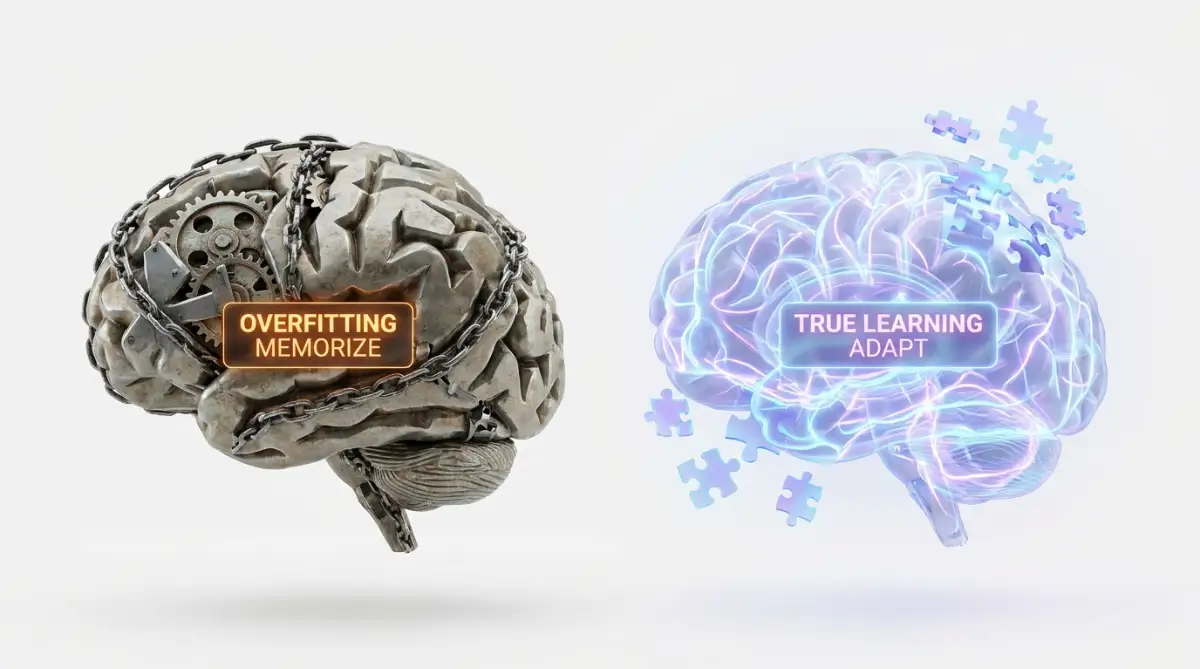
One of the most fascinating challenges in building these new systems is dealing with a problem called overfitting. To understand this, imagine a high school student studying for a massive final exam. Instead of actually understanding the underlying concepts, the student simply memorizes every single practice question word for word.
When the student takes the exact same practice test, they score a perfect 100%. But when the real exam introduces slightly different questions, the student fails completely. They learned the specific examples perfectly but failed to grasp the general knowledge needed to solve new problems.
This exact same phenomenon happens when you train a predictive algorithm too aggressively. The model basically memorizes your training data perfectly, capturing every single random noise and error present in that specific dataset. It looks incredibly smart on your local machine but becomes totally useless in the real world.
Are you struggling to grasp exactly how neural networks actually process these patterns? Check out this incredibly clear visual breakdown that explains the hidden layers without using a single line of complex math.
To prevent this memorization trap, you must hide a portion of your data from the algorithm during the training phase. You use this hidden information later as a surprise test to see if the model actually learned the core patterns. If it performs well on this unseen data, you know you have built a genuinely intelligent system.
Redefining Success: Why Accuracy Is Often a Giant Trap
In traditional software testing, a function either passes the unit test or it fails. You aim for a 100% pass rate before you push your code to the live server. When transitioning to predictive modeling, you have to let go of this perfectionist mindset.
Many beginners look at a metric called Accuracy to decide if their new model is good. If the system guesses correctly 95% of the time, it sounds like an amazing success story. However, relying purely on accuracy can easily trick you into launching a dangerously flawed application.
Imagine you are building a medical tool to detect an extremely rare disease that affects only 1% of patients. You could write a terrible, lazy program that simply outputs "No Disease" every single time, without even looking at the patient's data. Because the disease is so rare, your lazy program would actually be 99% accurate!
Despite that high accuracy, the system is completely useless and actively harmful. This is why you must start thinking about different ways to measure success. You need to understand the difference between a False Positive (crying wolf) and a False Negative (missing the actual danger).
Depending on your specific project, one type of mistake is usually much worse than the other. In our medical example, telling a healthy person they are sick is a minor inconvenience compared to telling a sick person they are perfectly healthy. You must tune your system to minimize the most dangerous mistakes, rather than just chasing a high overall accuracy number.
The Concept of Continuous Degradation
When you build a standard website, deploy it to a reliable server, and do not touch the code, it will generally keep working the same way for years. Traditional software only breaks when external systems change or servers physically crash. Predictive models, however, are essentially living things that slowly decay over time.
This decay is known as model drift, and it happens because the real world is constantly changing. A system trained to predict flight prices before a global event will suddenly become entirely inaccurate afterward. The data it learned from no longer represents the current reality of the market.
This means your job does not end when you successfully launch the application to your users. You have to build continuous monitoring systems that constantly check if the predictions are still reliable. When the performance starts dropping, you have to gather fresh data and retrain the whole system from scratch.
This creates an entirely new lifecycle for software maintenance. You are no longer just fixing bugs; you are actively managing the ongoing education of your application. Understanding this continuous feedback loop is what separates successful modern engineers from those who get left behind.
Embracing the Uncomfortable Learning Curve
Stepping into this new territory will feel deeply uncomfortable at first. You will read technical documentation that sounds like complex statistics rather than simple computer science. You will run experiments that fail for reasons you cannot easily trace with a standard debugging tool.
But the secret is to approach these concepts slowly, applying them to problems you already understand. You do not need a Ph.D. in mathematics to start building incredibly useful predictive features today. You just need patience, a willingness to experiment, and a deep respect for the data you collect.
Start by looking at the applications you maintain right now at your job. Ask yourself where a simple pattern-matching system could replace a messy, overly complicated set of strict rules. The moment you successfully replace a hundred lines of hardcoded logic with a single trained model, your whole perspective on programming will change forever.
Taking Your First Real Steps Into Intelligent Systems
Making the jump from traditional coding to predictive engineering feels overwhelming at first. You might think you need to immediately start building complex deep neural networks. In reality, the best approach is to start incredibly small and focus entirely on mastering simple concepts.
The most successful developers I know began their journey by playing with basic linear regression models. This is basically just drawing a smart line through a scatterplot of data points to predict a future trend. It sounds simple, but understanding how the computer adjusts that line will teach you the core foundation of everything else.
Before diving into complex math, you should spend time exploring high-quality introductory machine learning courses designed specifically for working professionals. These resources help bridge the gap between traditional logic and predictive statistics. They strip away the academic jargon and focus on practical application.
When you start practicing, privacy should be your number one priority. You will likely use public datasets and cloud-based platforms to train your early algorithms. It is incredibly important to learn about protecting private data in AI tools before you upload any real-world information.
Many new developers make the mistake of testing models using actual user databases from their workplace. This can easily lead to massive security breaches and legal trouble. You must read up on securing corporate data from leaks to ensure your learning process does not accidentally expose sensitive company secrets.
The Magic of Feature Engineering
Once you understand basic model training, you will discover a secret that separates amateurs from experts. This secret is called feature engineering, and it is entirely about human creativity. Feature engineering is the process of taking raw, boring data and transforming it into something the computer can easily understand.
Imagine you are building a system to predict whether a customer will buy a specific pair of shoes on a Tuesday. If you just feed the algorithm a giant list of raw dates, it will struggle to find any meaningful connection. A raw timestamp is just a confusing string of numbers to a basic algorithm.
However, if you extract the specific day of the week from that timestamp and create a new column called "Is_Tuesday," everything changes. You have suddenly isolated the exact variable the computer needs to notice. This simple human intervention makes the algorithm significantly smarter and faster.
You can apply your traditional software development skills perfectly here. Writing clean scripts to parse, clean, and reformat large datasets is exactly what you already do every day. Your ability to manipulate data structures efficiently gives you a massive advantage over someone who only studies the theory.
Understanding the Pipeline Ecosystem
Another essential concept to grasp is that a predictive algorithm does not live in isolation. A naked model sitting on your local computer is completely useless to your actual users. You have to build a reliable infrastructure to feed it fresh information and deliver its predictions to the front-end application.
This entire ecosystem is often referred to as MLOps, which stands for Machine Learning Operations. You need to learn the basics of managing machine learning operations to deploy your models safely into a production environment. This involves setting up automated testing, version control for your data, and continuous monitoring.
Traditional software engineers actually excel at building these pipelines. We already understand how to build REST APIs, manage database connections, and handle server load balancing. The artificial intelligence part is often just a tiny brain sitting in the middle of a massive, traditional software body.
If you try to learn the math, the deployment, and the data cleaning all at the exact same time, you will inevitably hit a wall. Managing your mental energy is just as important as managing your code. If you feel overwhelmed, take a step back and read about managing developer burnout so you can maintain a steady, healthy pace.

The Dangerous Traps That Break New AI Developers
The excitement of building your first predictive application can easily blind you to some devastating realities. I have seen countless experienced programmers deploy intelligent systems that completely ruined their company's reputation overnight. When traditional code breaks, it usually throws a loud error message and crashes safely.
When a predictive model breaks, it does not crash or show a red warning light. Instead, it quietly continues to work while confidently giving your users completely wrong answers. This silent failure is terrifying because you might not notice the damage until months later.
Reality Check: The Hidden Cost of Biased Data
Let’s look at a very common scenario that traps beginners constantly. Imagine you build an automated system to screen developer resumes for your HR department. You feed the algorithm ten years of past hiring data, assuming the computer will learn what a successful employee looks like.
You deploy the tool, and it immediately starts rejecting highly qualified candidates from specific backgrounds. Why did this happen? Because your historical data contained human biases from past hiring managers. The computer simply learned to replicate those exact same prejudiced decisions.
If you do not actively audit your datasets for fairness, you are just automating discrimination. Reading through academic studies on algorithmic bias is an absolute necessity for anyone building tools that affect human lives. You are responsible for the ethical output of your creations, not just the technical accuracy.
The Sunk Cost of Overcomplicated Architectures
Another massive pitfall is the obsession with using the newest, flashiest technology for incredibly simple problems. Many developers read an article about a massive new deep learning network and immediately try to force it into their small web app. They spend thousands of dollars on expensive cloud computing servers to run a heavy algorithm.
Meanwhile, a simple decision tree could have solved the exact same problem on a basic laptop for free. Complex models require massive amounts of data, take days to train, and are nearly impossible to debug when things go wrong. Start with the dumbest, simplest solution possible and only upgrade when that simple solution clearly fails.
Quick Reality Check: Complex vs. Simple Models
- The Myth: You need a massive deep learning neural network to build a smart application today.
- The Reality: Over 80% of real-world business problems can be solved perfectly with a simple, lightweight decision tree. Start dumb, test fast, and only upgrade when the simple math fails you.
The Trap of Blind Trust
Perhaps the most dangerous mistake of all is treating your new algorithm like an infallible oracle. Because the math feels complicated, developers sometimes assume the output must be a perfect truth. This leads to a dangerous habit of blindly passing the algorithm's decisions directly to the end user without any safety checks.
You must always build a safety net around your predictive features. If you are interested in why this matters so much, you should explore relying completely on AI outputs to understand the real-world consequences of unchecked automation. Always design your user interface so that a human being can override the computer's suggestion.
You need to maintain a healthy skepticism about everything your models produce. If a prediction looks too good to be true, your data is probably leaking the answer directly to the algorithm. Always double-check your evaluation metrics and ask a colleague to review your testing methodology.
Always remember that bad data is the root cause of almost every failed predictive project. You cannot fix a messy database by throwing a fancier algorithm at it. Understanding the importance of clean datasets will save you from pulling your hair out when your predictions suddenly stop making sense.
Your Roadmap to a Future-Proof Engineering Career
We are living through one of the most massive shifts in the history of software development. The days of writing thousands of strict rules to cover every possible edge case are slowly fading away. However, this does not mean your hard-earned engineering skills are suddenly worthless.
In fact, your ability to think logically and structure complex systems is more valuable now than ever before. Data scientists might know how to design a brilliant statistical equation, but they often struggle to turn that equation into a scalable web product. They need traditional developers to build the secure APIs, manage the databases, and create the user interfaces.
You do not have to become a full-time data scientist to succeed in this new era. You simply need to become a "Machine Learning Aware" software engineer. This means understanding how data flows into a model, how to interpret the results safely, and how to maintain the system over time.
By learning these foundational concepts, you immediately position yourself as a highly valuable asset to any modern tech company. You become the rare bridge between the theoretical world of statistics and the practical world of reliable software products. The developers who embrace this hybrid role will lead the next generation of application development.
It is completely normal to feel intimidated by the sheer volume of new information out there. Just take it one step at a time, build tiny projects that solve your own personal problems, and celebrate the small victories. Your perspective on problem-solving will slowly shift, and writing intelligent applications will eventually feel just as natural as writing a basic HTML page.
I know how scary it feels to step completely out of your comfort zone, but making this mental shift was honestly the best decision of my professional life. My best advice is to start small today, be patient with your progress, and trust that your foundation as a traditional coder gives you a massive advantage. You already have the logic inside you; now you just need to embrace the data, and I promise you will build incredibly impactful things.
Common Questions About Shifting to Predictive Development
Do I need to be a math genius to start building these features?
Not at all, because modern programming libraries handle all the heavy mathematical equations behind the scenes for you. You just need strong logical thinking and a solid understanding of how information flows through a system. As long as you understand basic concepts like averages and probabilities, you can start building highly effective predictive tools right away.
Will automated intelligent systems completely replace my coding job?
Automated tools will absolutely not replace smart software engineers, but engineers who use these tools will easily replace those who refuse to adapt. Your daily job will simply evolve from typing every single logical rule by hand to guiding and supervising intelligent algorithms. There will always be a massive demand for humans who can architect reliable, secure, and scalable software ecosystems.
Which programming language is the best starting point for this transition?
Python is universally recognized as the absolute best starting point because of its massive, beginner-friendly ecosystem. It is incredibly easy to read and features the most powerful open-source libraries for data processing and model training. Even if you write in JavaScript or C# for your day job, picking up Python for your data projects will make your learning journey significantly smoother.
How long does it realistically take to grasp these new concepts?
You can comfortably grasp the basic theory and core logic in just a few weekends of dedicated reading and video tutorials. However, building genuine real-world intuition takes a few months of hands-on practice with small, messy datasets. Consistency is key, so spending just an hour a day playing with simple models will yield amazing results over time.
Disclaimer: The information provided in this article is for educational and informational purposes only. It does not constitute professional career advice, formal technical training, or specific financial guidance. The transition into new software development methodologies involves inherent risks and technical challenges. Always consult with certified technical mentors or official documentation when applying these concepts to commercial or enterprise-level applications.