
The Silent Thief Stealing My Morning Energy
I used to wake up every single morning feeling like I had just wrestled a bear. My neck was incredibly stiff, and a sharp, nagging pain shot right down my lower back.
At first, I blamed my mattress. I even threw away my favorite pillows, thinking they were the main problem.
But the truth hit me hard one Tuesday afternoon while I was slouched over my laptop. I caught my reflection in the dark monitor screen. My shoulders were rounded forward, my neck was bent like a turtle, and my spine looked like the letter "C".
That was the exact moment I realized my daily habits were destroying my body. I was a victim of my own terrible desk setup.
This pain didn't just stay in my office; it followed me everywhere I went. I became short-tempered with my family because I was always in physical discomfort.
Playing with my kids on the living room floor became completely impossible. Just bending down to pick up a dropped pen felt like a massive, painful chore.
My mental peace was completely gone. Constant physical pain is incredibly distracting, making it nearly impossible to focus on deep, meaningful work.
I know I am not the only one fighting this silent battle. Millions of us sit for eight to ten hours a day, totally unaware of the heavy toll it takes on our bones and joints.
You might think that a little neck stiffness is just a normal part of being a working adult. But ignoring these early warning signs can lead to permanent damage that steals your joy and limits your movement.
The Hidden Mechanics of Forward Head Posture
Think of your head as a heavy bowling ball that weighs about 10 to 12 pounds. When your spine is perfectly straight, your neck easily supports this weight without any extra effort.
But every time you lean forward to look closely at your computer screen, you change the basic physics of your body.
For every inch your head moves forward, the pressure on your spine actually doubles. A slight lean can put up to 40 pounds of extra strain on your delicate neck muscles.
What actually happens inside your body?
Your spine is made up of bones called vertebrae, with soft, jelly-like discs sitting right between them. These discs act as shock absorbers for your everyday movements.
When you sit in a slouched position for hours, you squeeze the front of these discs very tightly. Over time, this uneven pressure pushes the jelly center backward, leading to a painful condition known as a bulging disc.
This extra pressure does not just stop at your lower back. It travels up through your shoulders, creating tight, painful knots in your upper back muscles.
Your nerves also get caught in this crossfire. When muscles get extremely tight, they can actually pinch the nerves that run down your arms.
Have you ever felt a weird tingling sensation or numbness in your fingers after a long day of typing? That is a direct result of bad posture choking your nerve pathways.

Myth vs. Reality: Desk Job Pain
Before we fix the problem, we need to stop believing common lies about office work.
- The Myth: Sitting up completely straight like a stiff board is the best posture.
- The Reality: Being extremely rigid is actually bad for your muscles. The best posture is relaxed, supported, and frequently changing.
- The Myth: Only heavy physical labor causes severe spinal damage.
- The Reality: Sitting still in awkward positions causes micro-traumas that build up quietly over many years.
Building Your Pain-Free Workstation From the Ground Up
You do not need to spend thousands of dollars on luxury office furniture to protect your back. You just need to understand how your body relates to your environment.
Let us break down the exact, actionable steps you can take right now to stop hurting yourself. We will start from your feet and work our way all the way up to your head.
Step 1: Master Your Lower Body Foundation
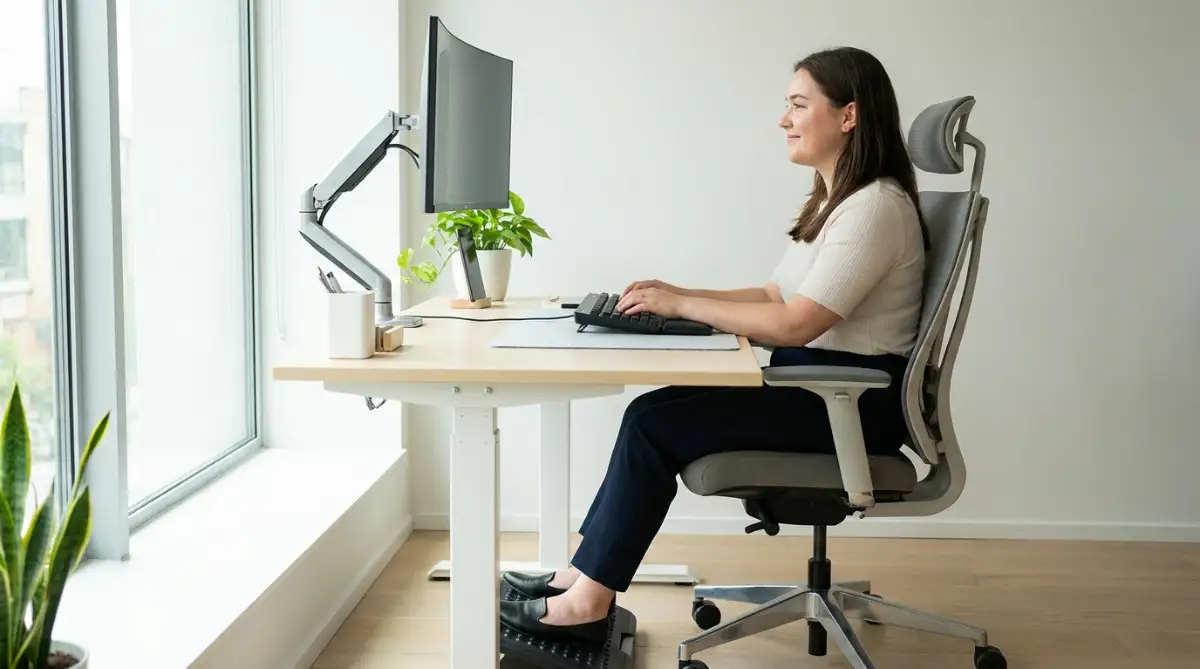
Your feet play a massive role in how your spine aligns itself. If your feet are dangling in the air, your lower back takes on all the stress of keeping you upright.
Always keep your feet completely flat on the floor. If your chair is too high and your feet cannot reach, put a sturdy box or a thick stack of books under them.
Your knees should be bent at a comfortable 90-degree angle. They need to be exactly level with your hips, or perhaps just a tiny bit lower.
When your knees are higher than your hips, your pelvis tucks completely backward. This motion instantly flattens the natural, healthy curve of your lower spine.
You want to maintain a slight, gentle arch in your lower back at all times. This brings us directly to the importance of the chair you choose.
My Personal Realization (Pro Tip): I spent months believing I needed a crazy expensive ergonomic chair to fix my lower back pain. Then, I simply rolled up a soft bath towel and placed it exactly behind my lower back curve while sitting in my cheap office chair. That completely free, two-second trick provided the instant lumbar support my spine was desperately craving.
Step 2: The Perfect Screen Height Formula
Your eyes completely control your neck. Where your eyes go, your head and neck will always follow.
If your monitor is sitting directly on your desk, you are forcing yourself to look down all day long. This causes that terrible "turtle neck" posture we talked about earlier.
The top third of your computer screen should be exactly at your natural eye level. When you look straight ahead, you should easily see the top edge of your browser window.
Here is an excellent guide to checking your alignment quickly.
Watch This Quick Posture Check
If you are struggling to find the perfect angle for your screen, this visual guide will make it incredibly simple. Take a few seconds to watch exactly how a healthy spine should look while sitting.
If you use a laptop, you are at a massive disadvantage. Laptops force you to bring your screen and keyboard close together, making good posture almost impossible.
Do yourself a massive favor and buy an external laptop stand to raise the screen. Then, plug in an external keyboard and mouse so your hands can stay low.
Step 3: Taming the "T-Rex Arm" Syndrome
Take a moment to notice where your elbows are right now. Are they reaching far out in front of you across the desk?
I call this the "T-Rex Arm" syndrome. When you stretch your arms far forward to type, your shoulders automatically round forward too.
This causes your chest muscles to become incredibly tight and short. At the same time, your upper back muscles become overstretched and extremely weak.
Bring your keyboard directly to the edge of your desk. Your elbows should rest comfortably at your sides, bent at a nice 90-degree angle.
Your wrists should float naturally over the keys, not bend sharply upward or downward. A padded wrist rest can help, but remember to rest your palms on it, not your delicate wrist joints.
The Secret Weapon: Active Sitting Strategies
Having the perfect ergonomic desk setup is only half of the winning battle. The other half involves how you actually use your body throughout the day.
Human bodies are highly complex machines designed for constant movement. We were never meant to lock ourselves into one single position for eight hours straight.
Even if your posture is absolutely perfect, sitting perfectly still will eventually cause muscle fatigue and joint stiffness. You have to introduce micro-movements into your daily office routine.
Sitting vs. Standing vs. Active Movement
You might have heard of the famous 20-20-20 rule for eye strain. Let's create a similar rule specifically designed for your spinal health.
Every 30 minutes, you need to stand up for exactly 30 seconds. You do not need to do a full workout; just break the static sitting pattern.
Reach your arms high above your head and take a deep breath. Squeeze your shoulder blades together tightly to wake up those upper back muscles.
Do a few gentle neck rolls from side to side to release the built-up tension. This simple act sends fresh blood and oxygen directly to your tired spinal discs.
Hydration also plays a surprisingly huge role in keeping your back pain-free. Those shock-absorbing discs between your bones are made mostly of water.
When you forget to drink water throughout your busy workday, those discs become dry and flat. A flat disc means less cushioning, which directly equals more bone-on-bone friction and pain.
Keep a very large glass of water sitting right next to your keyboard at all times. Not only will it keep your spine hydrated, but the frequent bathroom trips will force you to walk around.
By combining a smart physical desk setup with consistent daily movement, you can completely change your relationship with work. You do not have to accept physical pain as the normal price of earning a living.
Upgrading Your Workspace Beyond the Basics
Once you have your chair and monitor sorted out, it is time to look at the finer details of your workspace. Many people stop at adjusting their chair height and think their job is completely done. But true comfort comes from tweaking the hidden elements that quietly drain your physical energy.
One major factor that directly impacts your neck health is actually your office lighting. If a bright window sits right behind your monitor, your eyes will constantly fight the harsh glare.
When you struggle to see the text on your screen, you naturally lean your head forward without even realizing it. This tiny movement instantly breaks your perfect spinal alignment and brings back that terrible neck pain.
You should always position your desk so that natural light hits your workspace from the side. You can also look into applied ergonomic research regarding screen filters to heavily reduce unwanted glare.
Another secret to staying pain-free involves the actual temperature of your working environment. If your office is too cold, you will instinctively hunch your shoulders up toward your ears to stay warm.
Holding your shoulders tightly like this for hours creates massive tension knots in your upper back. Keep a comfortable sweater nearby so your upper body muscles can stay fully relaxed and loose.
The Hidden Connection Between Your Breath and Your Spine
Most people never connect their breathing habits with their daily back pain. When you slump deeply into your chair, your ribcage heavily compresses your lungs and diaphragm.
This collapsed posture makes taking a deep, healthy breath physically impossible. As a result, you start taking very shallow, rapid breaths using only your upper chest muscles.
Over a full workday, this shallow breathing pattern makes your neck and shoulder muscles incredibly tired. It also tricks your brain into feeling stressed, which makes your muscles tighten up even more.
Sit up tall, open your chest, and try taking a deep breath right now. Notice how much easier it is for your lungs to expand when your spine is properly stacked.
If you often find yourself feeling completely drained by 2 PM, poor oxygen flow might be the culprit. Taking a few minutes to step away from your digital devices to stretch and breathe can completely reset your energy levels.
Mastering Your Desk Accessories
The tools you interact with every single day can either help your spine or slowly destroy it. Think about your computer mouse, for example.
If you are using a tiny, flat travel mouse all day, your hand is forced into an unnatural, cramped claw shape. This tension travels straight up your arm and settles right into your shoulder joint.
Switching to a vertical mouse allows your hand to rest in a natural "handshake" position. This small change completely removes the twisting pressure from your forearm and elbow.
The same logic applies to your phone habits during working hours. Holding a phone between your ear and shoulder while typing is an absolute disaster for your neck vertebrae.
If you take a lot of calls, you absolutely must invest in a good pair of wireless headphones. You can easily find official workstation safety guidelines that heavily recommend hands-free devices for anyone working at a desk.
Expert Insight: I highly recommend organizing your immediate workspace so that your most-used items are within easy reach. Constantly stretching across a wide desk to grab a pen or notebook forces your lower back into an awkward, twisting motion. Keep your core tools close by, perhaps by organizing your digital workspace so you rely less on scattered physical papers.
The Silent Habits Sabotaging Your Spine
Even with a perfect desk setup, human error can quickly ruin your chances of living a pain-free life. We all have bad habits that we slowly develop over years of working on computers.
Breaking these habits is incredibly hard because they happen subconsciously while we are deeply focused on our work. Let us explore the most common traps that catch even the smartest office workers.
The "Couch Worker" Trap
Working from home has made the living room sofa look like a very tempting office chair. Sitting cross-legged on the couch with a laptop burning your thighs feels cozy for about ten minutes.
But your couch is specifically designed to make your body sink backward and completely relax. It offers zero structural support for your lower back curve or your pelvis.
When you sink into a soft cushion, your spine immediately rounds out into a terrible shape. After a few hours, you will try to stand up and feel a sharp, painful catch in your lower back.
This habit leads directly to chronic stiffness and can even trigger painful sciatica nerve issues. Always treat your couch as a place for resting, never as a primary place for serious work.
Ignoring the Signs of Early Fatigue
Your body is incredibly smart and will always warn you before a serious injury happens. The problem is that most of us simply ignore these quiet warning signals.
A dull ache in your shoulder or a slight numbness in your wrist is your body crying for help. Pushing through the pain because you have a deadline is the worst thing you can possibly do.
When you ignore early pain, your body tries to protect the hurting area by using other muscles to compensate. This throws your entire skeletal system out of balance.
Soon, a simple tight shoulder turns into a massive, pounding tension headache. You might end up spending thousands of dollars on physical therapy, which is why fixing posture now helps save money on expensive medical bills later on.
The Illusion of the "Perfect" Posture
Many people believe that bad posture can be fixed by simply forcing themselves to sit completely straight and stiff. They pull their shoulders back so hard that their muscles begin to shake with the effort.
This military-style posture is completely unnatural and will actually cause more pain than slouching. Your muscles are simply not designed to hold high tension for long periods.
When you try to force a rigid posture, your back muscles will eventually give out from pure exhaustion. Then, you will immediately collapse back into a terrible slump, feeling even worse than before.
The goal is to find a relaxed, balanced alignment where your bones do the supporting work, not your muscles. If you want to dive deeper into the mechanics of good posture, remember that comfort and gentle support should always be your main focus.
Forgetting to Hydrate Your Joints
I mentioned water briefly before, but this mistake is so common it deserves a deeper warning. When we get busy, drinking water is usually the first habit we completely drop.
Your spinal discs rely entirely on the water you drink to stay plump and functional. Without enough fluids, these tiny shock absorbers become brittle and extremely vulnerable to tearing.
Coffee and energy drinks do not count towards this goal, as they can actually dry you out further. Making sure you are staying properly hydrated is just as important as buying a nice chair.
If you feel a constant, deep ache in your lower back by the end of the day, your spine might simply be thirsty. Keep a large water bottle in your direct line of sight so you never forget to drink.
Trying to Multitask Through Physical Discomfort
When your back hurts, your brain is actively processing pain signals while also trying to read emails. This splits your focus and makes your work take much longer than it should.
You might think you are getting more done by working through the burning sensation in your neck. But the reality is that physical pain heavily impacts your cognitive abilities and decision-making skills.
The stress of multitasking and mental fatigue is heavily multiplied when your body is uncomfortable. You end up producing lower-quality work and making silly mistakes.
Take a ten-minute break to stretch out your back and reset your physical state. You will return to your desk with a clear mind and finish your tasks much faster.
Your Master Plan for a Pain-Free Workday
Fixing the way you sit at your desk is not a one-time event you can cross off a to-do list. It is an ongoing, daily practice of treating your body with the respect it deserves.
You now understand the hidden mechanics behind your daily aches and pains. More importantly, you know exactly how to adjust your environment to support a healthy, aligned spine.
Start small by adjusting your chair and monitor height right now before you do anything else. You do not need to fix every single bad habit today, just focus on making one positive change.
Tomorrow, you can focus on taking more frequent walking breaks or drinking an extra glass of water. Small, consistent improvements will compound over time and completely change how your body feels.
Remember that investing time in your physical workspace is a direct investment in your long-term health and happiness. You hold the power to prevent chronic lower back pain by making smart, informed choices about your daily habits.
You deserve to finish your workday with enough energy to actually enjoy your personal life. Stop letting a bad desk setup steal your joy, your mobility, and your peace of mind.
I know how frustrating it feels to battle constant aches, but I promise you that relief is entirely possible. My personal journey from daily back pain to total physical comfort started with just a few simple desk adjustments. Take these small steps today, and your future self will thank you for taking action!
Frequent Questions About Fixing Office Pain
How long does it take to correct bad desk posture?
Correcting years of bad habits usually takes about three to six weeks of consistent, daily effort. Your muscles need this time to slowly rebuild their strength and get used to a healthier, aligned position. Do not get discouraged if it feels slightly uncomfortable during the first few days of adjusting.
Is a standing desk better for lower back pain?
A standing desk can be incredibly helpful, but only if you use it correctly throughout the day. Standing for eight hours straight is actually just as damaging to your joints as sitting all day. The best approach is to switch between sitting and standing every 45 minutes to keep your body moving.
Can bad ergonomics cause chronic headaches?
Yes, terrible desk posture is one of the leading causes of tension headaches for office workers. When you constantly push your head forward to look at a screen, the muscles at the base of your skull become extremely tight. This massive tension travels up over your head, creating a painful, squeezing sensation.
Do posture correctors actually work for office workers?
Posture braces can offer a temporary reminder to pull your shoulders back when you start to slouch. However, wearing them too often will actually make your core muscles lazy and much weaker over time. It is always better to build your own natural muscle strength through targeted daily stretching and awareness.
Disclaimer: The information provided in this blog post is for educational and informational purposes only and does not constitute medical advice. Always consult with a qualified healthcare professional or physical therapist before making significant changes to your workspace or starting any new physical stretching routines. The author and publisher are not responsible for any adverse effects resulting from the use of the suggestions outlined in this article.