The Hidden Nightmare Behind That "Too Good to be True" Flight Deal
You finally spot it—that ridiculously cheap flight to your dream destination. Your finger hovers over the "book now" button, and you feel like you just found the ultimate travel hack. But before you hand over your credit card to that random booking site, let me save you from a mistake that costs travelers thousands of dollars every single day. I learned this the hard way so you do not have to.
That feeling of total helplessness is something I never want you to experience. When we search for flights online, the cheapest options always jump out at us, promising amazing savings. We click the book button, thinking we just scored the ultimate travel hack.
But those discount travel websites often hide a very dark secret in their fine print. They combine tickets from completely different airlines that have zero partnership with each other. This is known as a self-transfer connection.
If everything goes perfectly on time, you might actually save some money. However, the real world of travel is full of unexpected weather delays, technical issues, and long security lines. When things go wrong on a self-transfer ticket, nobody is coming to rescue you.
This daily struggle is completely unnecessary. Let us figure out exactly how these booking platforms trick you, and how you can take back control of your travel plans today.
Quick Takeaways for Smart Travelers
- Avoid the Baggage Trap: Self-transfers mean you have to collect and re-check your bags. Travel with a carry-on only if you use this method.
- Visa Warnings: Passing through baggage claim means you are officially entering the layover country. You might need a transit visa.
- MCT Matters: Never trust the booking site's connection times. Always give yourself at least a 4-hour window between self-transfer flights.
- Direct is Safer: Buying straight from the airline acts as free insurance. If they delay you, they rebook you for free.
Decoding the Self-Transfer Trap: What Actually Happens Behind the Scenes
When you buy a standard connecting ticket directly from a major airline, they offer you a strong safety net. If your first flight is late, they will automatically put you on the next available flight for free. They also transfer your luggage straight to your final destination behind the scenes.
Third-party travel websites do something completely different to lower the price. They act like a digital matchmaker, forcing two completely unrelated airlines into one journey.
Myth vs. Fact: The Third-Party Booking Reality
- The Myth: If one booking site sells me the ticket, they guarantee the whole trip.
- The Fact: The site simply runs a script to buy two separate tickets. If Airline A delays your flight, Airline B treats you as a "no-show" and keeps your money.
- The Myth: My bags will go straight to my final stop.
- The Fact: You must grab your bags, leave the secure zone, and wait in a brand new check-in line for the next flight.
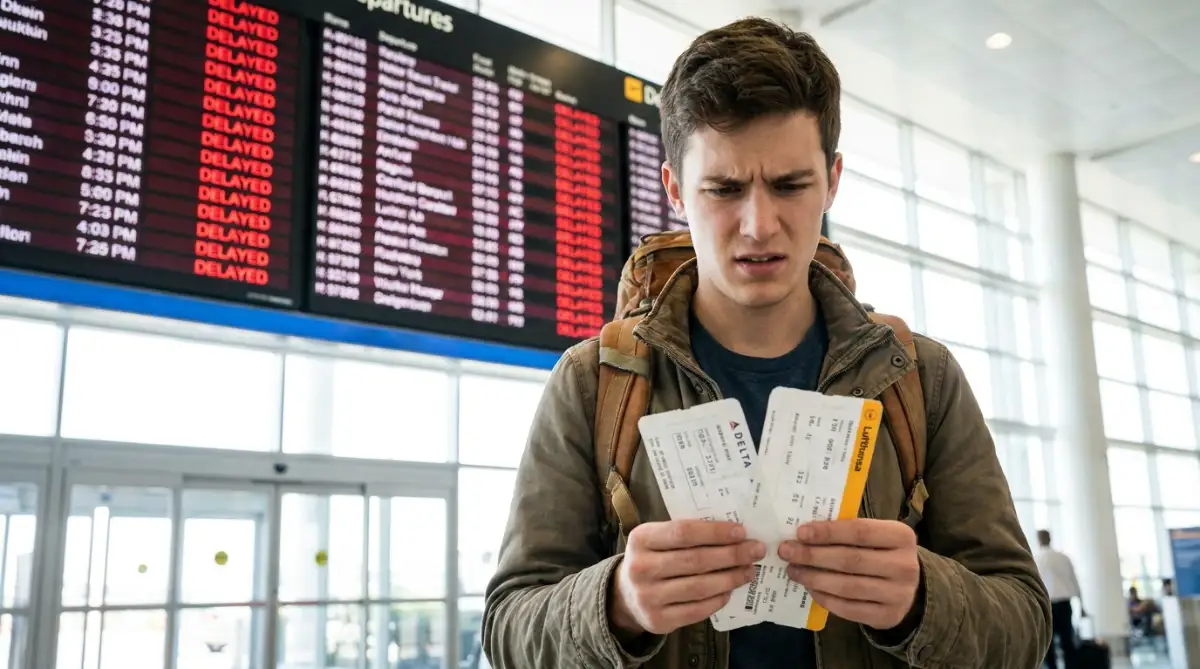
The Myth vs. Reality of Budget Flight Booking
Many travelers believe that holding one single confirmation email from a booking website means their whole trip is protected. This is a very common myth. The reality is that the booking website simply used a computer program to buy two separate tickets on your behalf.
Airline A does not care about Airline B. If Airline A arrives late, Airline B treats you exactly like a passenger who simply did not show up for their flight. You lose your money, your seat, and your temper.
To help you understand this better, think of a self-transfer flight like taking a public bus to catch a moving train. If the bus is caught in traffic, the train conductor is not going to wait for you.
The Heavy Burden of Baggage Claim
One of the most painful surprises of unprotected connections happens at the luggage carousel. When you travel on separate tickets, your checked bags will not magically follow you to your final destination.
You must wait at the baggage claim, collect your heavy suitcases, and then drag them all the way to the departure hall. After that, you have to stand in a long line to check those bags in with the second airline.

This entire process eats up a massive amount of time. A two-hour layover might sound like plenty of time when you look at it on a computer screen at home. But in a busy international airport, two hours can disappear in the blink of an eye.
Watch this helpful breakdown to understand the true cost of booking mistakes:
The Hidden Border Control and Visa Trap
Here is a terrifying scenario that ruins vacations every single day. Let us say you are flying from India to Canada, with a self-transfer layover in the United Kingdom.
Because you have to collect your luggage and re-check it, you are technically required to enter the United Kingdom. This means you must pass through their official passport control.
If you do not have a transit visa or a regular tourist visa for the UK, the immigration officers will not let you pass. Worse yet, your first airline might not even let you board the plane in India. They will look at your ticket, see the self-transfer, ask for your UK visa, and deny you boarding when you cannot produce one.
I always make it a rule to check the official airport website to see if terminal transfers require passing through border control. My personal habit is allowing at least four hours for any self-transfer, because rushing through security twice is something I never want to experience again.
Quick Transit Visa Reality Check:
Let me give you a real-life example. If you hold an Indian passport and book a self-transfer through Frankfurt (Germany) to reach Canada, you cannot just stay in the airport. Because you have to re-check your bags, you officially enter German soil. Without a valid Schengen visa, you will be denied boarding back in India. Always check the IATA Travel Centre website for exact visa rules before you buy.
How to Calculate Your True Minimum Connection Time
Airlines have something called a Minimum Connection Time (MCT) for their official flights. Travel portals often ignore these safety limits to create the absolute cheapest route possible.
If you decide you must book a self-transfer ticket, you need to become your own travel agent. You must calculate a safe buffer zone for yourself.
Start by checking the on-time performance history of your first flight. You can easily find this information on free flight tracking websites. If that flight is known for being delayed, you need to add an extra hour to your layover.
Next, research the layout of your connecting airport. Some massive international hubs have multiple terminals connected by trains that run every twenty minutes. Moving from Terminal 1 to Terminal 4 could take an entire hour just in walking and waiting.
Direct Booking vs. Third-Party Portals
Let us look at a clear breakdown of what happens during a travel disruption.
Looking at this simple comparison, it becomes very clear why direct bookings offer so much peace of mind. The small amount of money you save upfront on a travel portal is essentially an unpaid insurance premium.
Dealing with Customer Service Black Holes
Have you ever tried calling a budget travel agency when your flight is canceled? It is a deeply frustrating experience. You end up listening to hold music for hours while standing in a noisy airport terminal.
The airline staff behind the desk will look at your reservation and say, "You booked through a third party. We cannot touch this ticket. You have to call them."
When you finally reach a human on the phone, they often read from a prepared script. They will tell you that it is the airline's fault, and the airline will say it is the agency's fault. You become a ping-pong ball bouncing between two companies who refuse to take responsibility for your ruined trip.
The Psychological Relief of Doing It Right
We travel to explore the world, visit loved ones, and escape our daily routines. The journey itself should be an exciting part of the adventure.
When you book a protected ticket, or at least leave a massive time buffer for a self-transfer, your entire mindset shifts. You can actually sit down at the airport cafe, enjoy a warm cup of coffee, and read a book.
If a screen flashes that your flight is delayed, your heart does not sink into your stomach. You know that you are protected. You know that someone else is responsible for getting you to your final destination.
Smart Strategies for Budget Travelers
Does this mean you should never use third-party websites? Not exactly. These portals are fantastic research tools. They are excellent for finding out which airlines fly on specific days and comparing general price trends.
The smartest travelers use these search engines to find the best routes. Once they find a great itinerary, they open a new browser tab and go directly to the official airline website to make the actual purchase.
If the price difference is truly massive and you absolutely must book the self-transfer, you should always travel with only a carry-on bag. Removing checked luggage from the equation eliminates fifty percent of the risk.
Without checked bags, you can often check in online for your second flight. You can stay securely inside the transit zone of the airport without ever passing through passport control. You just walk from one gate to the next.
However, you must still ensure you have a very generous layover time. A carry-on bag will not save you if your first flight is delayed by three hours.
Mastering the Art of Travel Insurance
Another major mistake people make is assuming their basic travel insurance will cover a missed unprotected connection. Many cheap insurance policies specifically exclude self-transfer missed connections.
If you are going to take the risk, you need to read the insurance policy documents very carefully. Look for a clause called "Missed Departure" or "Connection Protection."
Some specialized third-party booking sites offer their own branded protection guarantees. They promise to buy you a new ticket if you miss the connection. While this sounds great, the terms and conditions are incredibly strict. You often have to prove that you followed all their complicated rules perfectly, or they will deny your claim.
Ultimately, education is your best defense against bad travel experiences. By understanding exactly how these ticketing systems work, you can make smart decisions that protect your hard-earned money and your sanity. You deserve to arrive at your destination feeling refreshed and excited, not exhausted and financially drained.
By applying these exact strategies, you transform yourself from a vulnerable consumer into a highly informed traveler. You take the power away from confusing booking algorithms and put it right back into your own hands. Traveling the world becomes a joy again, exactly as it was always meant to be.
Expert Strategies for Managing Unprotected Flight Connections
Taking control of your travel plans requires stepping out of the passenger mindset and thinking like a professional travel agent. You no longer have to rely blindly on the cheapest search results a website throws at you. Instead, you can build a customized safety net that protects your wallet and your sanity.
The smartest thing you can do before booking any complex route is to act as your own private investigator. You need to verify exactly how reliable your chosen airlines actually are. This process is much easier than it sounds.
By simply checking historical airline performance data, you can instantly see if your first flight has a bad habit of running late. If an evening flight is delayed forty percent of the time, you should never use it as the first leg of an unprotected journey.
I always tell my friends to look for early morning departures for their initial flight. Morning flights have the highest probability of leaving exactly on time. As the day goes on, air traffic jams and weather issues cause a ripple effect of delays across the entire aviation network.
Mastering the Art of Baggage Logistics
If you decide to brave a self-transfer journey, your suitcase is your biggest enemy. You must train yourself to travel light because checking a bag on separate tickets is incredibly dangerous.
When you fly with only a carry-on, you eliminate the need to stand in long baggage drop lines at your connecting airport. You can simply step off your first plane, pull out your phone, and head straight to your next gate. If you need help downsizing your packing habits, learning how to stop overpacking completely changes your travel logistics.
However, you must be extremely careful with budget airline rules. The second airline on your ticket might have completely different size and weight limits for carry-on bags. They will eagerly charge you massive penalty fees at the boarding gate if your backpack is even one inch too big.
Always measure your bags at home and compare them strictly to the requirements of the most restrictive airline on your itinerary. Being forced to check a bag at the last minute ruins the entire strategy and puts your connection at massive risk.
The Airport Layout Reality Check
Most travelers assume that arriving at the same airport means they just have to walk down a simple hallway. This is a very dangerous assumption to make.
Massive international hubs are basically small cities. Arriving at Terminal 1 and departing from Terminal 4 might require taking a shuttle bus that travels through heavy city traffic. Sometimes, these terminals are not even connected behind the security checkpoints.

You must manually research the official airport map before you ever click the buy button. You need to know exactly how long it takes to travel between your specific terminals. If the airport website warns that a terminal transfer takes forty-five minutes, you must factor that into your layover buffer.
Managing your physical and mental stamina during these long airport transfers is incredibly similar to maximizing your EV battery life on long cross-country road trips. You have to conserve your energy, plan your route carefully, and never push your limits to the absolute edge.
Clever Pricing Hacks and Alternatives
Sometimes, the booking portal shows you a cheap price that actually disappears when you reach the checkout page. The travel industry is famous for using tracking cookies to create a false sense of urgency.
If you are trying to piece together two separate one-way tickets yourself, always open a private browsing window. Understanding how tracking impacts flight prices can help you avoid sudden price jumps while you finalize your separate bookings.
If building a manual connection feels too stressful, strongly consider alternative transportation for short distances. Instead of risking a separate domestic flight, maybe you can take a high-speed train for that specific leg of the journey. Trains rarely require passing through extensive security checks and offer a much more relaxing experience.

The Most Expensive Travel Traps You Must Avoid
When travelers try to outsmart the system without doing proper research, they often fall into terrible financial traps. These mistakes do not just ruin vacations; they drain bank accounts and cause immense emotional distress. Let us look at the painful realities of getting it wrong.
The Same-Day Walk-Up Fare Nightmare
Imagine sprinting to the boarding gate, sweating and out of breath, only to see the doors close right in front of your face. You missed your unprotected connection by just five minutes. Because you bought separate tickets, the staff will calmly tell you that your ticket is now worthless.
This means you have to walk over to the sales desk and buy a brand-new ticket for a flight leaving today. Airlines know that desperate people have no negotiating power. A ticket that cost fifty dollars online a month ago might suddenly cost eight hundred dollars at the airport counter.
You are forced to hand over your credit card with tears in your eyes just to get home to your family. The tiny amount of money you saved by using a third-party portal is instantly wiped out by this massive emergency expense.
The Hidden Visa Denial Trap
This is perhaps the most heartbreaking mistake of all. Many people book cheap routes that have a layover in a country like the United States, the United Kingdom, or Australia. They assume they do not need a visa because they are just passing through the airport.
However, because it is a self-transfer ticket, you technically have to enter the country to collect your bags and check in again. Before you book, you absolutely must spend time verifying strict transit visa requirements directly with official immigration authorities. If you do not have the proper paperwork, your very first airline will deny you boarding at your home airport.
Missing a critical check-in or boarding window due to bad paperwork is exactly as unforgiving as failing to meet strict domain name expiration deadlines. Once the system closes you out, there is absolutely no going back.
The "Fake" Connection Guarantee
Many budget booking websites heavily advertise a "connection guarantee" to make you feel safe. They promise to rebook you for free if a delay causes you to miss your second flight. People buy these tickets feeling completely protected.
Sadly, the fine print of these guarantees is designed to make you fail. If your first flight is delayed, they usually require you to call their specific hotline within a tiny twenty-minute window to report it. If you are stuck on a plane without internet access, you obviously cannot make that call.
When you finally land and contact them, they will reject your claim because you missed their reporting deadline. You are left completely stranded in a foreign country with zero support.
The Shared Network Illusion
People often think that all airlines communicate with each other behind the scenes. They assume that if they are delayed, the system will automatically alert their next flight to hold the plane. This simply does not happen with self-transfer tickets.
Understanding your official passenger rights is incredibly important when dealing with these situations. Government aviation rules clearly state that airlines are only responsible for the specific journey they sold you.
Booking a protected, direct itinerary with one major airline is like investing in a dedicated, secure virtual private server for your business. You get a solid foundation where everything is officially managed and supported by one trusted company.
When you choose the third-party budget option, you are completely on your own. You are trusting two massive, disconnected corporations to accidentally line up perfectly on the exact day you decide to travel.
The Domino Effect of Canceled Tickets
There is one final trap that catches even experienced travelers completely off guard. When you buy a round-trip ticket from a third-party portal, it is sometimes built as a series of separate one-way tickets.
If you miss the very first flight of your journey, some systems will automatically cancel every other flight attached to that reservation. They label you as a "no-show" and wipe out your return flights without offering any refund.
You do not just lose the missed connection; you lose your entire vacation itinerary. You have to start completely from scratch, buying flights for your whole family at peak last-minute prices. This single mistake has ruined countless honeymoons and family reunions.
Your New Blueprint for Stress-Free Adventures
Traveling should fill your soul with excitement, not fill your stomach with dread. You now possess the insider knowledge to look right past those misleadingly cheap price tags. You know exactly what happens behind the scenes when you hand over your money to a budget travel portal.
You no longer have to cross your fingers and pray that your flights align perfectly. By booking direct, packing light, and calculating your own safe layover times, you take total command of your journey. You can confidently navigate the world without fearing hidden fees or sudden cancellations.
I want you to close this page feeling incredibly empowered about your next big trip. My absolute favorite part of traveling is sitting at the departure gate with a hot coffee, knowing my itinerary is completely safe and sound. Start applying these smart booking habits today, and I promise your future travel experiences will be infinitely more enjoyable!
Common Questions About Unprotected Flight Connections
What happens to my checked bags on a self-transfer flight?
You must personally collect your bags from the luggage carousel at your connecting airport. Afterward, you have to take them to the departure hall and wait in line to check them in with your second airline. Your bags will never be transferred automatically.
Can I get a refund if I miss my self-transfer connection?
No, the second airline will not give you a refund or a free new ticket. Because you bought separate tickets, they treat a missed connection exactly the same as if you simply decided not to show up. You will have to buy a new ticket with your own money.
Is a two-hour layover enough for separate airline tickets?
In most major airports, two hours is incredibly risky for unprotected tickets. You have to account for getting off the plane, walking long distances, waiting for bags, and clearing security a second time. Most experienced travelers recommend a minimum of four hours for domestic transfers.
Do I need a visa for a self-transfer layover?
Yes, you usually need a valid visa to legally enter the layover country. Because you must collect luggage and re-check it, you are technically leaving the international transit zone. Always verify the specific rules of your layover country before buying the ticket.
Will my travel insurance cover a missed separate ticket?
Basic travel insurance policies often reject claims involving missed self-transfer flights. You must purchase a highly specific policy that explicitly covers "unprotected connections" or "missed departures." Always read the fine print of your policy carefully before assuming you are covered.
Disclaimer: This article is for informational and educational purposes only. Flight rules, visa requirements, and airline policies can change at any time without notice. Always verify your specific travel requirements with official airlines, immigration authorities, and your travel insurance provider before making any financial decisions.