Drowning in Bills? My Honest Journey Out of the Financial Maze
Waking up in the middle of the night just to stress over four different credit card bills is the absolute worst feeling. Your checking account empties out before you even buy groceries, and every unknown phone call makes your stomach drop. I know what it feels like to hide from the mail carrier. Let's talk about a real, no-nonsense way to clean up this mess and finally get your breathing room back.
I was exhausted, highly anxious, and deeply ashamed of the massive financial mess I had created. I tried to completely ignore the paper statements piling up on my kitchen counter, but the math never lied to me. That awful feeling of being trapped by my own spending choices almost ruined my mental peace completely. I knew I needed a solid way out before my entire life collapsed around me.
Many people walk around every single day carrying this exact same invisible weight on their shoulders. You go to work, smile at your friends, and pretend everything is totally fine. But inside, your brain is constantly doing a stressful calculation of due dates, minimum payments, and rising interest charges.
The Bottom Line (Quick Read)
- Merge the mess: Turn 5 stressful due dates into 1 simple monthly payment.
- Shop smart, not hard: Use soft credit checks to find the best loan rate without hurting your score.
- Keep old cards alive: Cut up the plastic to stop spending, but keep the actual accounts open to protect your credit history.
- Build a shield: Save $1,000 in cash fast so a broken car doesn't force you right back into credit card debt.
Escaping the Chaos: How to Actually Merge Your Balances
Finding a real solution begins with a complete shift in how you view your money problems. When you have five different balances, your brain treats them like five separate monsters attacking you at once. The main idea here is to capture all those separate monsters and put them into one single cage.
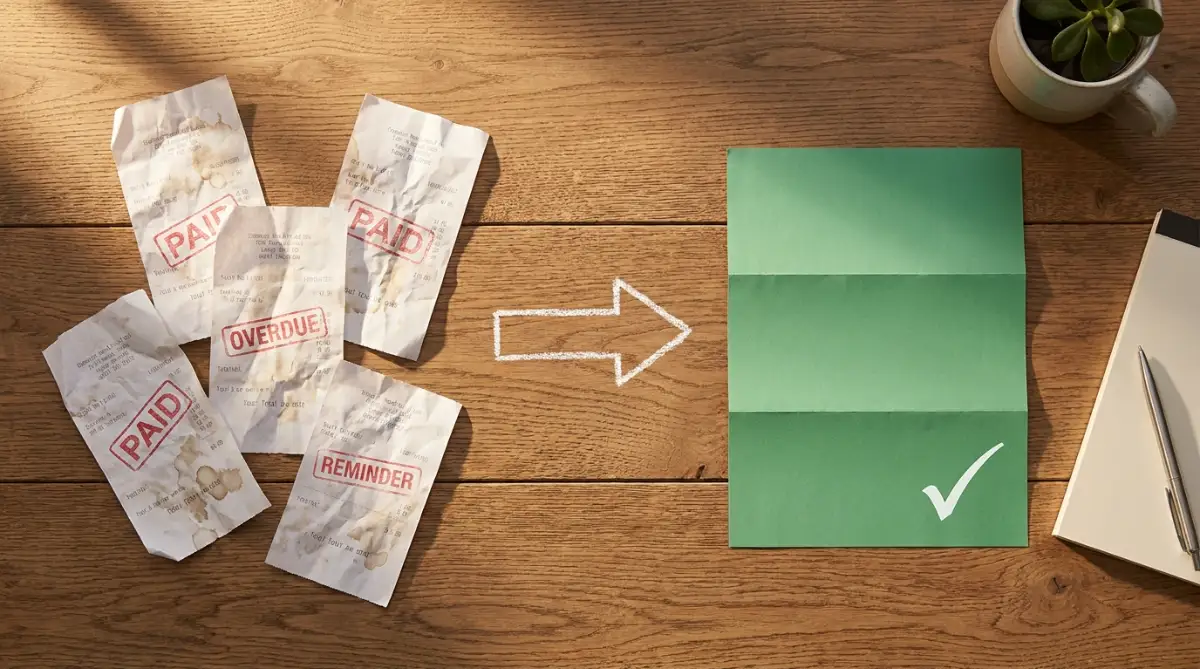
This single cage is what banks call a consolidated loan, and it completely changes the game. Instead of remembering five due dates, you only have to remember one single day of the month. This immediately frees up a massive amount of mental space that you used to spend worrying.
But you cannot just blindly rush into a bank and demand a new loan without a solid plan. You need to understand exactly what is happening behind the scenes before you sign any paperwork. Let us break down the exact actions you need to take to protect yourself and your future.

Facing the Real Numbers Without Fear
The absolute hardest part of this entire journey is sitting down and looking at the ugly truth. You have to gather every single bill, statement, and hidden balance you have been avoiding. You need to know the exact amount you owe, right down to the very last penny.
I used to hide my smallest bills in a drawer, thinking if I didn't see them, they somehow did not matter. But writing down every single debt on one big piece of paper was the most powerful thing I ever did for my finances.
Create a simple list that includes the name of the lender, the total balance, and the current interest rate. You will probably feel a bit sick to your stomach when you see the final total number. But please remember that this number is just a starting point, not your permanent destination.
Once you have this master list, you have successfully taken away the unknown fear. You now have a clear target to aim at, which makes the whole process feel incredibly real and manageable.
Understanding the Magic of Single Interest Rates
Let us talk about why having multiple small balances is so dangerous for your wealth. Each credit card acts like a tiny vacuum cleaner, sucking extra money out of your pocket through high-interest charges. If you have three cards charging you twenty percent interest, you are bleeding money every single day.
When you merge these accounts, your main goal is to find a new lender who offers a much lower rate. Imagine trading in three hungry vacuum cleaners for one small, highly efficient machine. You still owe the same total amount of money, but it costs you significantly less to carry it around.
This means a much larger portion of your monthly payment actually goes toward reducing the main balance. You stop feeding the greedy credit card companies and start paying yourself back instead. Over a few months, this simple mathematical shift can save you thousands of hard-earned dollars.
The Psychology of a Single Monthly Goal
Human brains are incredibly bad at multitasking, especially when it comes to financial stress and planning. Having multiple due dates scattered throughout the month keeps you in a constant state of mild panic. You never really get a chance to relax because the next payment is always just a few days away.
When you transition to just one single payment, something amazing happens to your mental health. You pay that one bill, and then you are totally completely free to breathe for the rest of the month.
You can finally start looking ahead to your future instead of constantly putting out fires from your past. This psychological relief is honestly worth just as much as the actual money you save on interest. You regain control over your daily routine, and your confidence begins to slowly return.
Preparing Your Financial Profile for Success
Before you even think about filling out an application online, you need to check your own financial temperature. Banks are extremely careful about who they lend money to, and they will judge your past behavior. They will pull your credit report to see if you are a responsible person or a high-risk borrower.
You should always pull your own report first to check for any silly mistakes or errors. Sometimes an old bill that you already paid off still shows up and ruins your overall score. Disputing these errors before you apply can easily boost your chances of getting a fast approval.
Lenders also heavily look at your debt-to-income ratio, which is just a fancy way of comparing what you earn to what you owe. If you owe too much compared to your monthly salary, they will politely reject your request. You might need to pick up a temporary side job just to boost your income numbers before applying.
Check out this amazing breakdown before moving forward:
Myth vs. Fact: The "Hard Pull" Scare
- The Myth: Checking my own credit score will drop my points and make me look bad to banks.
- The Fact: Pulling your own report is called a "soft inquiry" and it does absolutely nothing to your score. You can (and should) check your numbers for free on sites like AnnualCreditReport before a lender ever looks at your file
The Danger of Opening New Accounts
A huge mistake many people make is randomly applying for five different loans at the exact same time. They think this increases their chances, but it actually destroys their credibility instantly. Every single time you submit a hard application, it leaves a temporary negative mark on your record.
When a bank sees five recent applications, they assume you are completely desperate for cash. This makes you look like a massive risk, and they will run away from you very quickly. You must be extremely strategic and only apply for offers that you are highly confident you will get.
Many modern lenders offer a soft pre-approval check that does not hurt your score at all. Always use these soft checks to shop around for the best possible rate before making your final move. Patience is your best friend when hunting for the perfect financial rescue package.
Real Talk Q&A: Should I just use a 0% balance transfer card?
- If you can pay off the debt in 12-18 months: Yes! A 0% card saves you a ton of money on interest.
- If you need 3-5 years to pay it off: Stick to a fixed-rate personal loan. If you don't clear the credit card before the promo ends, they often slap you with all the backdated interest at once. Ouch.
Comparing Unsecured vs Secured Options
When you start shopping around, you will notice there are two main flavors of loans available to you. The most common type is completely unsecured, meaning the bank trusts you based only on your good word and history. These are much safer for you, but they usually come with slightly higher interest rates.
The other option requires you to put up something valuable as a guarantee, like your house or your car. This is called collateral, and it usually unlocks the absolute lowest rates available in the market. However, you are taking a massive personal risk by betting your physical property.
If you somehow lose your job and cannot pay, the bank can legally take your home or vehicle away. I always strongly advise people to stick with unsecured options unless they have an incredibly stable and guaranteed income source. Your peace of mind is always worth paying a slightly higher percentage rate.
The Balance Transfer Card Strategy
Sometimes you do not even need a traditional loan to successfully merge your accounts together. Many credit card companies offer special introductory promotions with zero interest for over a year. This is called a balance transfer, and it can be a highly powerful tool if used correctly.
You essentially move all your high-interest balances over to this brand new, shiny zero-percent card. Every single dollar you pay for the next twelve to eighteen months goes straight directly to the main principal. This is an incredibly fast way to aggressively kill your debt if you are highly disciplined.
However, there is a very dark side to this strategy that traps thousands of regular people. If you do not pay off the entire amount before the promotion ends, the interest rate shoots up dramatically. You must have a strict mathematical plan to eliminate the balance before the clock totally runs out.
Building a Bulletproof Monthly Budget
No financial product in the world can permanently save you if you do not fix your daily spending habits. Getting a new loan simply treats the symptom, but your everyday choices are the actual root cause of the problem. If you continue spending more than you earn, you will quickly end up in double the trouble.
You need to sit down and build a realistic budget that you can actually stick to without feeling miserable. Categorize your expenses into absolute needs, like housing and food, and pure wants, like dining out.
Cut out the subscriptions you forgot about and the expensive coffee runs that drain your wallet daily. Redirect all that saved money directly toward your new single monthly payment. The faster you clear this new balance, the faster you achieve true, lasting financial freedom.
Myth vs Reality in Financial Planning
Many folks believe that getting a new loan instantly fixes all their past mistakes overnight. The reality is that this process is merely a helpful tool, much like a hammer used to build a house. You still have to do the heavy lifting and actually swing the hammer yourself every single month.
Another highly common myth is that closing your old accounts immediately helps your overall standing. Actually, closing old credit cards can instantly drop your score by messing up your total available credit ratio. Keep those old accounts open, but physically cut up the plastic cards so you cannot use them again.
You must be totally honest with yourself about your weaknesses and spending triggers. If you know that late-night online shopping is your downfall, delete all your saved payment information from your phone. Small, smart friction points like this can save you from repeating your old, painful mistakes.
Staying Motivated During the Long Journey
Paying off massive amounts of money is definitely not a fast sprint; it is a very long, tiring marathon. There will absolutely be months where you feel incredibly frustrated and want to quit entirely. You will see your friends buying new things and going on fancy vacations while you are strictly budgeting.
During these tough moments, you need to firmly remind yourself why you started this journey in the first place. You are buying back your mental peace, your sleep, and your future happiness. Celebrate the small wins, like when your total balance drops below a specific milestone number.
Maybe reward yourself with a completely free activity, like a nice hike or a movie night at home. Staying positive and completely focused on the end goal will help you push through the hardest days. You are totally capable of beating this, one single smart payment at a time.
Beyond the Basics: Pro Strategies for Lasting Financial Health
Getting approved for a new loan is really just the opening chapter of your wealth-building story. You have successfully merged your accounts, but keeping that balance going down requires a totally new mindset. If you want to protect your hard work, you have to build a system that protects you from your own spending habits.
The most powerful secret to long-term success is treating your new monthly payment like an absolute non-negotiable tax. You cannot look at this bill as something you will pay only if you have leftover money at the end of the month. Instead, you need to set it up so the money leaves your account the exact same day you get paid.
By automating daily tasks like your bill payments, you completely remove human emotion from the equation. You cannot accidentally spend money at the mall if the bank has already transferred it to your lender. This simple robotic habit guarantees you will never miss a due date and protects your growing credit score.
The Psychology of the Emergency Shield
One of the biggest reasons people fall back into massive debt is because they never expect life to go wrong. Your car will eventually break down, your roof will leak, or you might face an unexpected medical bill. If you do not have cash waiting for these moments, you will go straight back to using your credit cards.
Financial experts often recommend building a tiny safety net before you aggressively pay down your new loan. Even a simple starter fund of one thousand dollars can completely change how you handle sudden stress. According to resources from the American Psychological Association, having a cash buffer significantly reduces daily anxiety and improves your overall mental clarity.
Think of this emergency fund as a heavy shield that protects your new financial plan from flying arrows. When a surprise expense hits you, you simply pay for it in cash and continue your life normally. You never have to touch a plastic card, and your new loan balance continues dropping exactly as planned.
Mastering the Art of Direct Negotiation
Many folks think they are completely at the mercy of the big banks when they apply for financial relief. The truth is that lenders are businesses, and they actually want to keep you as a paying customer. Before you even sign a brand new contract, try picking up the phone and talking to your current creditors.
You can often call your credit card company and honestly explain that you are struggling to keep up. Ask them directly if they have any internal hardship programs that can temporarily lower your interest percentage. Sometimes, they will freeze your interest entirely for a few months just to help you catch up on the principal amount.
This aggressive negotiation tactic is exactly what you learn when mastering the basics of debt consolidation early on. If your current bank agrees to lower your rate, you might not even need to apply for a brand new loan. You save yourself the hassle of a hard credit check and still get the exact same financial relief.
The "Snowball" Backup Plan
Sometimes, you might get approved for a new loan, but the bank does not give you enough money to cover everything. You might be able to pay off three cards, but you still have one stubborn medical bill left behind. In this specific scenario, you need a smart backup strategy to handle that leftover balance.
This is where the famous debt snowball method becomes your absolute best friend and secret weapon. You take all of your extra energy and throw it at that one remaining small bill while paying the minimum on your new big loan. The psychological boost you get from totally destroying that tiny bill will give you amazing momentum.
Once that small bill is totally gone, you take that extra cash and add it to your main loan payment. This creates a massive snowball effect where your payments get bigger and stronger every single month. Your balances will start dropping so fast that you will actually get excited to check your accounts.
Auditing Your Monthly Subscriptions
A huge hidden drain on your daily wealth comes from tiny digital subscriptions that you completely forgot about. You might be paying ten dollars a month for a streaming service you have not watched in almost a year. These tiny leaks in your bank account add up to hundreds of wasted dollars that could go toward your freedom.
Take a Sunday afternoon, sit down with a cup of coffee, and look at your last three bank statements. Highlight every single automatic charge and honestly ask yourself if that service brings you true joy or value. If the answer is no, cancel it immediately without any second thoughts.
Redirecting these small, wasted amounts into your financial plan can shave entire months off your repayment timeline. It is not always about making a massive salary; sometimes, it is just about keeping the money you already make. Every single dollar you rescue from a useless subscription is a dollar that buys back your future peace of mind.

The Dangerous Traps That Keep You Broke
Trying to fix your money problems can sometimes feel like walking through a dark forest full of hidden traps. Many honest, hard-working people completely ruin their fresh start because they make a few highly predictable mistakes. If you do not recognize these pitfalls early, you will end up in a much worse situation than when you started.
The most tragic thing I see is when someone successfully merges their accounts but refuses to change their daily lifestyle. They get a brand new loan, pay off all their old accounts, and suddenly feel incredibly rich. This false sense of extreme security is the absolute biggest threat to your entire recovery process.
The Illusion of Freed-Up Credit
Imagine logging into your banking app and seeing zero balances on four different credit cards. For the first time in forever, you have thousands of dollars in available limits just sitting there waiting. Your brain starts whispering that it is totally fine to buy that expensive new phone because you have the room for it.
This is exactly how the terrible cycle restarts, and it happens much faster than you might think. You start swiping your old cards for small things like dinners and new clothes, promising you will pay it back. Before you even realize what is happening, those old cards are totally maxed out again.
Now, you have the massive payment from your new consolidated loan, plus the massive payments from your newly maxed-out cards. You have effectively doubled your total burden, and this time, no bank is going to save you. You must aggressively fight the urge to use those freshly cleared cards for any reason whatsoever.
Falling for Shady Relief Scams
When you are desperately searching for a way out, you become a massive target for dishonest companies. You will start seeing flashy online ads promising to magically erase your balances for pennies on the dollar. They will ask you to stop paying your bills entirely and send your cash directly to them instead.
These shady organizations are incredibly dangerous and can completely destroy your financial reputation in a matter of days. The Federal Trade Commission frequently warns consumers about these predatory relief programs that charge massive upfront fees for zero results. If a company promises a magical, instant fix without any hard work, they are almost certainly lying to your face.
Always remember that you must legally spot hidden dangers in loan contracts before handing over your personal information. A legitimate bank will completely explain their fees, their interest rates, and their exact repayment schedule upfront. If someone tells you to hide information from your current lenders, run away as fast as you possibly can.
The Danger of Securing Unsecured Debts
We briefly touched on this earlier, but it is such a massive pitfall that it deserves a deeper, emotional warning. Sometimes a bank will offer you an incredibly low interest rate if you agree to put your family home up as collateral. This sounds like an amazing deal on paper because the monthly payment is so comfortably low.
But you are effectively taking normal consumer debt, which is just numbers on a screen, and attaching it to the roof over your head. If you lose your job or get extremely sick, the bank does not care about your personal struggles at all. They will start the legal foreclosure process and forcefully kick your family out onto the street.
No amount of saved interest is ever worth risking the safe place where your children sleep at night. You must protect your physical assets by understanding your home insurance details and keeping your property totally separate from your credit card mistakes. Always keep your unsecured mistakes totally unsecured, even if it costs you a few extra dollars every month.
Closing Old Accounts Out of Anger
Once you finally pay off a credit card that has been causing you intense stress, your first instinct is to destroy it. You want to call the bank, yell at the customer service agent, and aggressively close the account forever. You think this action will protect you from ever using that terrible piece of plastic again.
However, the major credit bureaus heavily calculate your score based on how much overall credit you have available versus how much you use. If you suddenly close a massive account, your total available pool shrinks dramatically in an instant. This makes it look like you are suddenly using a huge percentage of your remaining credit, which drops your score like a rock.
Instead of officially closing the account, just cut the physical card into tiny pieces with a sharp pair of scissors. Delete the saved card numbers from all your favorite online shopping websites and mobile wallet apps. The account stays open and healthy on your official record, but you physically cannot spend any money on it.

Ignoring the Blended Interest Math
A very sneaky mistake happens when people do not actually calculate the math on their old accounts correctly. You might have one card charging twenty-five percent, but another small loan only charging you six percent. If you roll everything into a new loan at twelve percent, you are actually losing money on that smaller debt.
You should only merge the accounts that actually have a higher interest rate than the brand new offer you receive. It makes absolutely zero mathematical sense to move a cheap balance into a more expensive package just for convenience. You have to put your emotions aside and look at this purely as a strict mathematical business decision.
Sometimes the smartest move is a partial combination strategy where you leave the low-interest accounts totally alone. The goal is not just to have one payment; the actual goal is to pay the absolute lowest amount of total interest possible. Taking an extra twenty minutes to do this simple math can easily save you thousands in the long run.
Your Personal Blueprint for a Debt-Free Tomorrow
The journey to completely taking back your life from aggressive lenders is rarely a perfectly smooth ride. You are unlearning years of bad financial habits while trying to build a totally new system for your future. There will absolutely be days where you feel incredibly tired and want to just give up on the whole budgeting process.
But every single time you make that new, unified payment, you are actively buying back a piece of your personal freedom. You are setting yourself up to finally focus on building true wealth, planning for retirement, or maybe even starting a business. The heavy, dark cloud of money anxiety will slowly begin to lift, and you will physically feel lighter every morning.
Proper money management is basically just a series of small, smart choices repeated over a very long period of time. Just like finding out what insurance agents keep secret about coverage, educating yourself gives you the ultimate power to win. Keep pushing forward, stay honest with your daily budget, and never let temporary setbacks completely derail your entire mission.
I clearly remember the exact Tuesday morning I made my final, crushing payment to the bank and watched my balance hit zero. The overwhelming wave of pure relief and intense pride that washed over me is a feeling I deeply want you to experience for yourself. Start your new plan today, forgive yourself for past mistakes, and confidently take your financial life back into your own hands!
Common Questions About Merging Your Finances
Does combining my loans temporarily hurt my credit score?
Yes, you will usually see a very small, temporary dip in your numbers when the bank does a hard inquiry on your report. However, as you consistently make your new single payments on time, your score will usually bounce back and eventually go much higher. The long-term benefits to your credit health easily outweigh that tiny initial drop.
Can I include my old student loans in a personal consolidation plan?
While it is technically possible with some lenders, it is rarely a good idea to mix educational debt with standard consumer credit. Federal student loans have special built-in protections, like income-based repayment and pause options, that you permanently lose if you move them to a private bank. You should generally look into securing a student loan refinancing program specifically designed for education instead.
What should I actually do if the bank rejects my application?
First, take a deep breath and immediately ask the lender for an "adverse action notice," which officially explains exactly why they said no. Usually, it means your debt-to-income ratio is simply too high, or there is an active error sitting on your public report. Focus on manually paying down your smallest balance to improve your ratio, and wait at least three to six months before trying again.
Is using a promotional balance transfer card better than a standard bank loan?
A balance transfer card is incredibly powerful because it offers zero percent interest, meaning every dollar kills your principal balance directly. However, it is only better if you are highly disciplined and absolutely guarantee you can pay it off before the promotional window totally closes. If you need more than eighteen months to pay off the total amount, a standard fixed-rate loan is usually the much safer choice.
Do I really need to hire an expensive company to do this for me?
Absolutely not; you can do this entire process completely by yourself for free by directly contacting a local credit union or online bank. Many third-party companies charge completely outrageous hidden fees just to fill out the exact same basic paperwork you could do on your laptop. Taking the time to understand the process yourself keeps all your hard-earned money safely inside your own pocket.
Disclaimer: The information provided in this article is for educational and informational purposes only and does not constitute professional financial, legal, or tax advice. We strongly recommend consulting with a certified financial planner or a registered credit counselor before making any major decisions regarding your personal loans or credit accounts.