The Hidden Frustration of Learning Artificial Intelligence
Ever tried to figure out how computers 'think' and ended up with a massive headache? You are certainly not alone. I used to assume machine learning was an exclusive club meant only for math geniuses in lab coats. But the truth is, it gets a whole lot simpler once you throw away the confusing tech jargon. Let's break down how artificial intelligence actually learns—using plain English and everyday examples. No advanced math degree needed, I promise.
It took me months of painful trial, endless error, and lots of self-doubt before I finally cracked the code. You are probably feeling that exact same deep frustration right now as you read this. Everywhere we look, people are talking endlessly about artificial intelligence and smart algorithms.
It often feels like a secret, exclusive club where everyone else knows the hidden password except for you. Ordinary people like you and me just want a simple, clear explanation without all the confusing industry jargon. We want to understand the magic behind the screens without needing a university degree in advanced mathematics.
That is exactly why I decided to sit down and break this entire concept into bite-sized, digestible pieces just for you. We are going to strip away the complicated math entirely and look at how things really work behind the scenes.
Inside This Guide (Quick Takeaways):
- The Flashcard Method: Machine learning is just teaching computers through clear, repetitive examples.
- Features & Labels: The basic inputs (clues) and outputs (answers) that make AI work.
- Algorithms are just math recipes: Different problems require different logic, like Decision Trees or Linear Regression.
- Quality over Quantity: A computer fed with messy data will only give you messy predictions.
Stripping Away the Mystery: How Computers Actually Learn
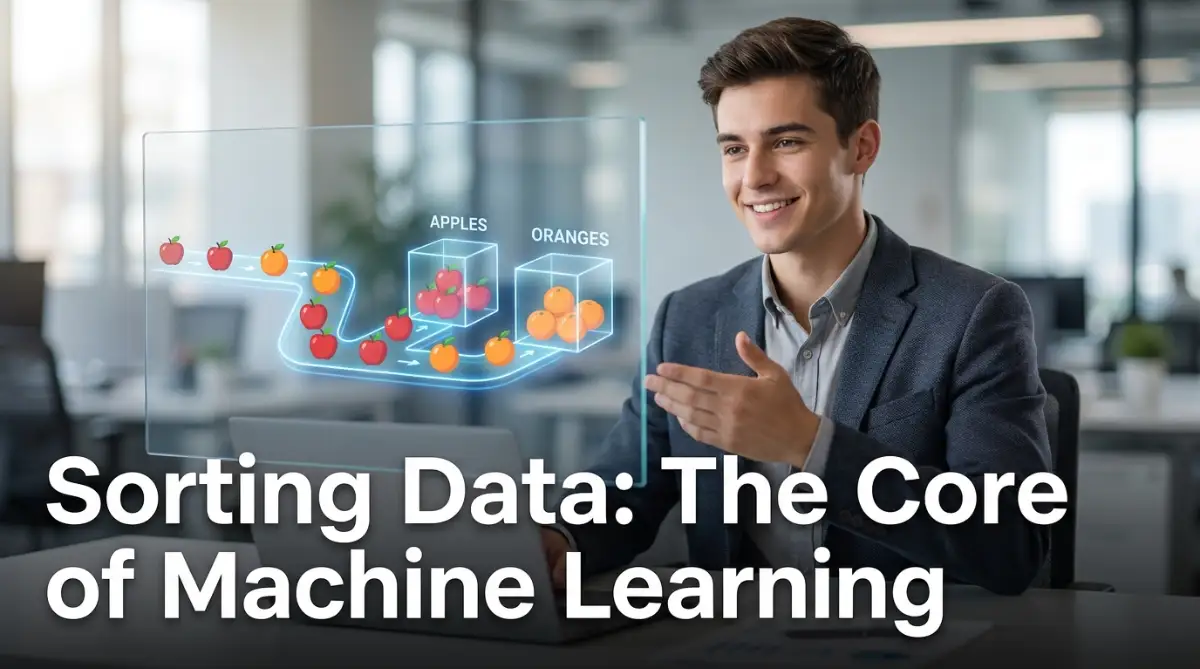
To understand how we teach computers, we need to forget about robots and servers for a moment. Instead, I want you to think about how you would teach a small toddler to recognize different types of fruit. You would not just hand the child a thick biology book and expect them to figure it out alone.
You would grab a stack of simple flashcards to make the learning process easy and visual. You would hold up a picture of a round, red object and clearly say, "This is an apple." Then, you would hold up a long, yellow object and say, "This is a banana."
You repeat this process patiently over and over again. After showing the child fifty different pictures of apples and bananas, their brain starts to pick up on the hidden patterns. They notice that color and shape are the big clues.
When you finally show them a brand new picture of an apple they have never seen before, they can proudly shout out the correct answer. This exact process of learning through clear examples is the absolute core of supervised machine learning.
We are acting as the patient teacher, and the computer program is our eager student. We give the computer thousands of examples, complete with the correct answers, so it can learn the underlying patterns.
The Magical Ingredients: Features and Labels
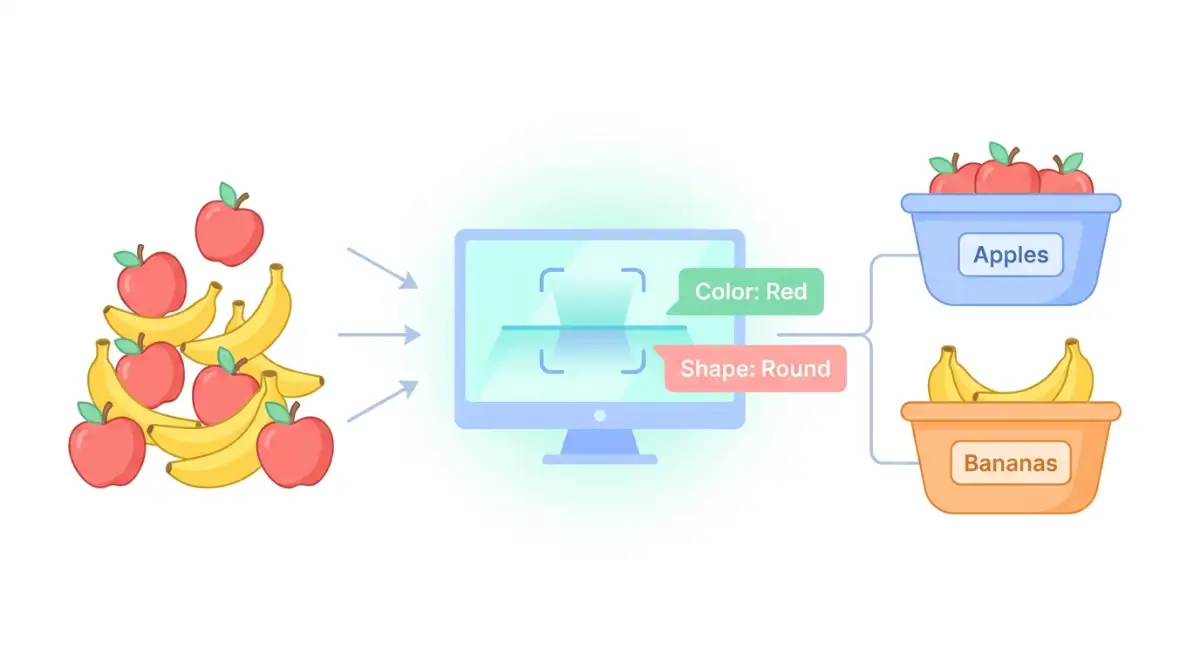
In the professional tech world, they use fancy words to describe our simple flashcard game. The pictures of the fruits we show the computer are called Features. Features are simply the unique characteristics or details of the thing we want to study.
For an apple, the features would be its red color, its round shape, and its smooth texture. The correct answer that we provide to the computer (telling it that it is indeed an apple) is called a Label.
When we give a computer both the features and the labels together, we call it labeled data. Supervised machine learning cannot exist without this beautifully labeled data. It is the absolute lifeblood of the entire operation.
Think about your email inbox and how it magically filters out unwanted junk messages. The engineers at Google or Microsoft fed their computers millions of old emails to teach it the difference between good and bad messages.
The features were specific things like words written in ALL CAPS, suspicious links, or the phrase "You won a lottery." The label was simply a tag that said either "Spam" or "Not Spam."
Quick Cheat Sheet: Features vs. Labels in Everyday Life
To make this super clear, here is how you can spot features and labels in tools you already use:
I made a huge mistake when I first started learning about this fascinating topic.
I used to think I needed a powerful, expensive computer to understand how data training actually works. My realization was that you can grasp the entire concept just by drawing inputs and outputs on a cheap piece of paper! You just need to understand what information goes in, and what answer comes out.
Visualizing the Computer's Brain in Action
Seeing the learning process happen in real time can make everything click instantly in your mind. Sometimes, reading text is not enough to truly grasp how a machine adjusts its internal rules based on the data we feed it.
Watch this incredibly clear visual breakdown that shows exactly how a computer program learns from labeled examples.
Once the computer studies enough of these labeled emails, it builds a set of internal rules. We call this set of rules a Model. The model is basically the computer's newly trained brain.
Now, when a brand new, unseen email arrives in your inbox tomorrow morning, the model scans it quickly. It looks at the features of the new email, compares it to everything it learned in the past, and makes a highly educated guess.
If the guess is correct, your inbox stays clean and organized. The most amazing part is that the computer did not just memorize the exact emails we showed it earlier. It actually learned how to identify the general concept of spam itself.
Exploring the Most Popular Decision Makers
Now that we know we have to feed the computer labeled examples, we need to understand how the computer actually processes those examples. There is no single, magical brain that does all the work.
Instead, there are many different mathematical recipes, which we call Algorithms. You can think of an algorithm as a specific type of logic or a unique way of solving a puzzle.
Different problems require different types of logic to get the best results. Let us walk through a few of the most popular algorithms using completely everyday scenarios.
The Trend Spotter: Linear Regression
Imagine you are trying to sell your house and you want to know exactly how much money you can get for it. You look at all the recent house sales in your friendly neighborhood.
You notice a very clear, simple pattern. Houses with more square footage generally sell for a lot more money. If you plot these past sales on a piece of graph paper, you would see a bunch of dots forming a line going upward.
Linear regression is an algorithm that essentially draws the best possible straight line through all of those historical dots. Once that magical line is drawn, you can use it to predict the future.
If you know the square footage of your own house, you just find that number on the graph, look at where the line is, and you instantly get a highly accurate price estimate. It is heavily used for predicting actual numbers, like future temperatures, company sales, or stock prices.
The Great Divider: Logistic Regression
Despite having a very similar name to the previous algorithm, logistic regression does something entirely different. It does not try to predict a specific, continuous number like a price or a temperature.
Instead, it tries to sort things into very specific, neat categories. Remember our spam email example from earlier? That is the perfect job for this specific algorithm.
It looks at the data and draws a firm boundary line directly in the sand. Anything that falls on the left side of the line belongs to category A (Not Spam). Anything that falls on the right side belongs to category B (Spam).
It is absolutely perfect for answering simple "Yes or No" questions. Will this customer buy this product? Yes or no. Does this medical x-ray show a broken bone? Yes or no.
The Question Master: Decision Trees
Have you ever played the popular game Twenty Questions? You start by asking broad questions to narrow down the possibilities.
You might ask, "Is it an animal?" If the answer is yes, you then ask, "Does it live in the ocean?" You keep asking smaller and smaller questions until you finally guess the correct answer.
A Decision Tree algorithm works in exactly the same fun way. It looks at a massive pile of data and starts asking a series of logical "Yes or No" questions to split the data up.
Let us say a bank wants to decide if they should give someone a big car loan. The decision tree might first ask, "Is their income above a certain amount?"
If yes, it moves to the next branch and asks, "Do they have a good credit score?" By following these simple branches all the way to the end, the computer reaches a final, highly accurate decision.
The Myth vs. Reality of Machine Predictions
When ordinary people start learning about artificial intelligence, they often carry a lot of heavy misconceptions. Hollywood movies have completely twisted our understanding of what these computer programs can actually achieve.
- The Myth: Supervised learning models are completely independent and can learn anything on their own.
- The Reality: They are completely helpless without humans. We must manually collect, clean, and perfectly label the data before the computer can even begin to learn.
- The Myth: These algorithms never make a mistake and are always 100% accurate.
- The Reality: They only make educated guesses based on the past data we gave them. If we feed them bad or biased data, they will confidently give us completely wrong answers.
- The Myth: You need to be a math genius to use these tools in real life.
- The Reality: Today, there are hundreds of user-friendly software platforms that handle the heavy math for you. You just need to understand the basic logic and know how to organize your data properly.
Why Quality Always Beats Quantity
One of the biggest lessons you must learn as an absolute beginner is the extreme importance of data quality. You might think that feeding a computer a billion examples will automatically make it incredibly smart.
However, if those examples are messy, confusing, or incorrectly labeled, the computer will become horribly confused. It is exactly like feeding a top-tier athlete a diet of pure junk food and expecting them to win a gold medal.
The output is directly determined by the quality of the input. Data scientists spend almost eighty percent of their working hours just cleaning and organizing data.
They fix spelling mistakes, remove duplicate entries, and ensure every single label is perfectly accurate. Only after the data is perfectly clean do they finally hand it over to the learning algorithms.
Expanding Your Mind to Real-World Magic
Now that you understand the basic mechanics, you will start noticing supervised machine learning everywhere in your daily life. It is quietly working behind the scenes to make your life smoother and more efficient.
When you open your favorite streaming app on a Friday night, it magically recommends a movie you end up loving. That is a supervised learning model that studied your past watching habits and matched them with similar users.
When you use your credit card in a foreign country and the bank instantly texts you to confirm it is not stolen, that is another algorithm at work. It learned the normal patterns of your spending and flagged something that looked completely out of character.
Even modern farming uses these amazing algorithms. Drones fly over massive fields taking millions of pictures of crops. The computer models, trained on labeled images of sick and healthy plants, can instantly tell the farmer exactly which areas need more water or medicine.
By simply understanding the basic concept of features and labels, you have already unlocked the greatest secret of modern technology. You are no longer just a passive consumer of artificial intelligence. You are now stepping into the light as someone who truly grasps how the digital world operates around us.
Taking Your First Steps into Advanced Data Modeling
Now that you understand the basic mechanics behind the curtain, you are ready to take things a step further. I want to share some incredibly practical secrets that professional data scientists use every single day. These are not complicated mathematical formulas. They are simply smart, logical habits that separate a beginner from a true professional.
When I first started building my own simple predictive models, I thought I had to use the most complex algorithms available. I wrongly believed that a harder method would automatically give me much better results. This is a very common trap for beginners.
The truth is quite the opposite in the real world of technology. You should always start your journey with the absolute simplest solution possible. A basic logistic regression model is incredibly fast to build and very easy to explain to your boss or your clients.
If a simple model solves your problem ninety percent of the time, there is absolutely no need to overcomplicate things. You only move on to complex methods when the simple ones completely fail to give you a good answer. This mindset saves you an enormous amount of time and heavy frustration.
If you are curious about what happens when you do need massive complexity, you might eventually want to explore a guide to deep learning. But for now, let us stick to our beautifully simple supervised methods.
The Secret Recipe: Splitting Your Data
Here is a brilliant trick that completely changed how I look at machine training. You should never, ever show the computer all of your labeled examples during the learning phase. If you give it all the answers upfront, you have no way to test if it actually learned the core concept.
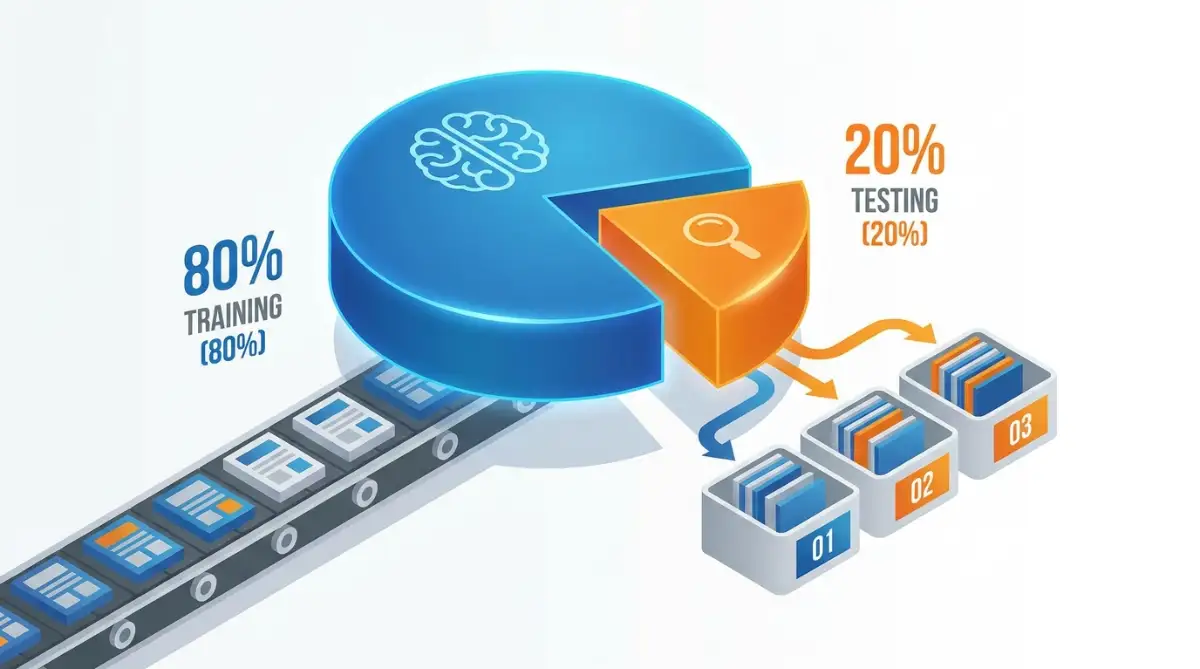
Instead, professionals split their data into two completely separate piles. We call the big pile the Training Set, which usually contains about eighty percent of all our historical examples. The remaining twenty percent goes into a hidden pile called the Testing Set.
Myth vs. Reality: Why We Split Data
- The Myth: You should feed the AI 100% of your data right away to make it as smart as possible.
- The Reality: If you don't save that 20% for testing, you will never know if the AI actually learned the patterns or if it just lazily memorized the answers. It is exactly like giving a student the answer key before a big test!
You use the big pile to teach the computer exactly how to spot the hidden patterns. The machine studies these examples for hours, adjusting its internal rules until it feels highly confident. But the real magic happens during the final exam.
You take that hidden twenty percent of data and hide the correct labels from the computer. You ask the machine to make fresh predictions on this new, unseen information. Because you secretly know the correct answers, you can instantly grade the computer's performance like a strict school teacher.
This testing phase is absolutely non-negotiable if you want to build trust in your system. It is exactly like testing custom software before you release it to paying customers. If the computer completely fails the test on the hidden data, you know it is not ready for the real world yet.
Monitoring for Changes in the Real World
Another major secret is understanding that the world around us changes every single day. The patterns that were incredibly true yesterday might be completely false tomorrow. We call this frustrating phenomenon data drift.
Let us imagine you built a wonderful model to predict which winter coats people will buy online. You trained your computer using five years of historical shopping data, and it worked perfectly. But what happens if a sudden, unexpected heatwave hits your city in the middle of December?
People will suddenly stop buying heavy coats and start buying light jackets instead. Your predictive model will completely panic because this new shopping behavior does not match the old patterns it learned. It will continue recommending thick winter coats, and your sales will crash instantly.
This is exactly why you must constantly monitor your algorithms after they go live. You have to feed them fresh, updated examples every few weeks so they can adapt to new trends. Understanding this simple concept will easily put you ahead of most beginners in the field.
I realized this the hard way when an old project of mine stopped working simply because user behavior had naturally shifted over a few months. My big realization was that a machine learning model is like a living garden. You cannot just plant the seeds and walk away; you have to water and maintain it continuously.

The Hidden Traps That Destroy Predictive Models
Learning how to build these smart systems is exciting, but there are massive landmines hidden along the path. If you do not know where these traps are, you can easily destroy your entire project. I have seen incredibly smart people make these painful mistakes because they rushed the process.
When an algorithm makes a terrible mistake, it does not just show an error code on a screen. It can actually cause real financial damage or ruin a company's reputation overnight. You have to approach this technology with a healthy amount of respect and caution.
Before we look at the specific mistakes, it is always smart to think about overall security. If you are handling sensitive user data to train your systems, you must prioritize protecting your personal information. Bad data practices will ruin you faster than a bad algorithm ever could.
The Danger of Memorization
The single most common mistake in supervised learning is a terrible habit called Overfitting. This happens when your computer model acts exactly like a lazy high school student cramming for a math test. Instead of learning how to actually solve the formulas, the student just memorizes the exact answers from the practice book.
When the student takes the real exam and sees a slightly different question, they fail miserably. A computer model does the exact same thing if you train it too intensely on a small set of data. It memorizes the specific noise and random details of your training examples instead of the broad, general patterns.
Imagine teaching a model to recognize pictures of dogs, but all your training photos happen to have a bright green grassy background. The overfitted model will wrongly assume that "green grass" is the main feature of a dog. If you show it a picture of a dog sitting on a blue carpet, it will confidently tell you that it is not a dog at all.
This kind of failure can be embarrassing and costly. If you want to dive deeper into how complex models handle huge amounts of information, you can read about how generative models learn. It highlights why broad, diverse examples are so incredibly important.
Feeding the Machine Garbage
There is an old, famous saying in the computer science world: "Garbage in, garbage out." It sounds like a funny joke, but it is a harsh reality. Your predictive model is completely blind and deaf; it only knows what you choose to feed it.
People often get highly impatient and throw messy, unorganized data straight into the algorithm. They leave empty rows in their spreadsheets, spell words incorrectly, and mix up their category labels. The computer tries its best to find patterns in this chaotic mess, but it ends up learning complete nonsense.
Poor data quality is a massive financial drain on modern businesses. According to top industry analysts, maintaining high data quality standards is a massive challenge for almost every major corporation today. If you do not clean your spreadsheets carefully, your final predictions will be entirely useless.
The Invisible Enemy: Algorithmic Bias
This is perhaps the most dangerous and emotional pitfall of all. We often think of computers as perfectly fair, logical, and unbiased machines. But remember, the computer learns entirely from historical data created by highly flawed humans.
If your historical data contains unfair human prejudices, the computer will quickly learn those prejudices and amplify them. Let us say a company uses an algorithm to sort through job applications. If the company historically hired mostly men for leadership roles, the computer will assume that being male is a positive feature for success.
It will automatically start rejecting highly qualified female candidates because they do not fit the historical pattern. This destroys lives and creates massive legal nightmares for businesses. Understanding and understanding algorithmic bias is an absolute necessity for anyone working with modern technology.
You must constantly question your own data and look for hidden blind spots. If you plan to use these tools for your own business, you should carefully research the risks of adding AI to your site. Taking a few extra days to audit your data for fairness can save you from a major public relations disaster.
Your Blueprint for Mastering Smart Algorithms
We have covered an enormous amount of ground together, and you should feel incredibly proud of yourself. You started this journey feeling confused by the heavy jargon of artificial intelligence. Now, you confidently understand how features, labels, and training data work together to create magic.
You know that linear regression draws a line to predict numbers, while decision trees ask simple questions to split things up. More importantly, you understand that these machines are not magical, independent thinkers. They are highly dependent tools that rely entirely on the quality of human instruction.
By splitting your data into training and testing piles, you can prove that your models actually work in the real world. By constantly checking for data drift, you ensure your predictions stay highly accurate over a long period of time. These simple, foundational concepts will carry you incredibly far in your tech journey.
As you continue to explore this fascinating field, always remember to prioritize safety and fairness. Government organizations are constantly updating guidelines on managing AI risks effectively to protect everyday consumers. Staying informed about these safety standards will make you a much more responsible and respected professional.
It is also incredibly smart to think critically about every new app you download. For example, you might want to question whether certain privacy concerns with AI apps are worth the convenience they offer. Knowledge truly is your strongest shield in this digital era.
The absolute best way to solidify this new knowledge is to start looking for hidden patterns in your own daily life. Notice how your email filters behave, or how your favorite online store recommends new products to you. You will quickly realize that supervised machine learning is happily working all around you, every single day.
I remember feeling so empowered the very first time I correctly identified an algorithm working in the background of my favorite app. My hope is that you take this newfound confidence and start exploring simple data projects for yourself today. You absolutely have what it takes to master this technology and use it to completely transform your future.
Common Questions Beginners Ask About AI Training
What is the simplest definition of supervised machine learning?
It is a process where a computer learns by studying hundreds or thousands of clear examples that already have the correct answers attached to them. Just like a student studying with flashcards, the computer finds patterns so it can eventually guess the correct answer on a brand new card.
Do I need to be a math expert to use these algorithms?
Absolutely not! Today, there are hundreds of user-friendly software tools that handle all the heavy mathematical lifting completely behind the scenes. You simply need to understand the basic logic, know how to organize your spreadsheets neatly, and ask the right questions.
How is supervised learning different from unsupervised learning?
Supervised learning uses data that already has clear, specific labels and correct answers attached by humans. Unsupervised learning uses completely raw, unlabeled data and forces the computer to find its own hidden groupings without any human help or guidance.
How much data do I actually need to train a good model?
There is no single magic number, but generally, you need several hundred highly accurate examples to get a basic model working well. The quality of your information is always much more important than the massive quantity of it.
Can a predictive model be 100 percent accurate all the time?
No, it is practically impossible for any model to be perfectly accurate every single time it makes a guess. Real-world data is naturally messy and unpredictable, so these tools are designed to give you highly educated probabilities, not absolute certainties.
Disclaimer: The information provided in this article is for general educational and informational purposes only and does not constitute professional technical, financial, or legal advice. While every effort has been made to ensure accuracy, the world of software and artificial intelligence changes rapidly. We highly recommend consulting with certified professionals or verified documentation before making significant business decisions or implementing complex data systems.